HAPPY DIRT DAY – oops, sorry EARTH DAY!

Yes, it is that time of year again where we all pause for a moment to see the damage we are personally causing to the earth and if we can fix it.  I checked out several articles this last week on a variety of topics, the ones that caught my eye were about an individual’s past.

celebrate earth day

My past has some lumps and bumps in it but overall very few regrets.  I think one of my biggest regrets was not paying enough to my carbon footprint when I was young.  I NEVER threw trash out the window of the car (parents would have slapped me silly for a stunt like that), which is good, however;  I used to trust the bug killers back then, and that was bad.nasty bug spray

I didn’t catch on to the whole “earth-friendly” movement until the late 70’s (boo hiss).  I didn’t care what I ate or where it came from as long as I didn’t have to make it – fast foodaholic!  I also didn’t think twice about the plastic soda pop bottle I threw in the trash.

clean earth

The thinks (yes thinks not things as it took me a while to think of them – another proud idiot moment for me – woo hoo!) I know now are:

  • Reduce, recycle, reuse, repurpose everything I put my hand on. I three two are easy enough to manage, the last – repurpose – is my most fav one.  I blame my mother for this!  She was what we affectionately labeled her “a Dumpster Diver”!! (get out of the gutter for a moment!)  She could not pass up a junk (yard) sale, junk (2nd hand) store, or even an actual dump site.  It was not totally her fault.  She grew up during the depression, and they learned to save everything, just in case you needed it for something at a later date.  So rummaging around at flea markets, garage/yard sales, second-hand stores, and even dumps (trash places) was one of her most favorite things to do.  We three sisters all have this addiction which has also passed on to my eldest sister’s son (in truth he is worse than all three of us girls combined!).
  • NO CHEMICALS! Organic was the big “it” thing from decades ago.  As time and governments passed, the organic certification came about.  The funny thing about getting the organic certification is you can still use up to 15% chemicals on your plants (including food) and are still allowed to be called organic – bummer!  We prefer “natural” because all that we do on our tiny piece of earth is natural.
    • Companion planting.
    • Good bug attraction planting.
    • Weed removal by hand or earth-friendly methods (vinegar works great for a ton of bad weeds)
    • Using other things like feeding birds to deter (eat) bad bugs, setting water out (We have a pond and a creek in our field, and a coy pond in the front yard with easy ways for the honey bees to reach the water.  We also float wood in there during the hottest parts of summer in case they fall in.), allowing our goofy chickens to roam freely (might have to re-think this idea if they don’t stay out of our plots) and eat bad critters (grubs, grasshoppers, etc.), the guineas also get to roam about
  • Water conservation and sustainable farming/gardening practices.

every day earth day

Well, once again my trusted Farmer Almanac has provided  us all with some help:

15 Things YOU Can Do to Protect the Earth.

They have some of the great old standbys like eat green, waste reduction but they are also sharing ways to save with heating and cooling – nice guys!!  Oh, and I love the “Remember Mom’s Advice part – my mom was full of them!  In fact, thinking back now, I do not think there was a single conversation with mom that did not carry some type of mom-ism in it.

earthday chocolate

My final thought on this wonderful Earth Day 2017: (you must sing this…) It’s not easy being green.  Having to be the same color as the leaves and the trees… (Don’t you just love Kermit the Frog!)

kermit easy being green

Follow my blog with Bloglovin

DID YOU JUST TOUCH MY FOOD?

The ugly storms that came through Colorado decided to dump moisture almost everywhere but here – boo hoo!  With the temps jumping back into the 70’s tomorrow, my hose team (which is just me dragging out a bazillion hose’s) is set up and ready to go.  Now I am thinking about what to share with you over this next month.

(When you realize your hose is old-)

cartoon hose

My thoughts, topics, and ideas usually get inspiration from all the different emails regarding farming and gardening.  Most are just shares, some are things to buy, and some are of a more serious nature.  Those of you that have been following me know how I do not care much for the serious.  I get too serious and have a bad tendency to get on my soapbox and rant.  That is the biggest reason I shy away from them – however – that being said:

I want to share that I support this organization (not financially because I am broke, but I do sign petitions and emails to the Government):

http://www.centerforfoodsafety.org/about-us

The reason why I connect with them instead of worrying about the FDA is simple – – – ACTION!  They are working hard to try to assure us that our food sources are decent and safe to eat.  I live for this way of life.

where food comes from

Yes, we do have to buy some things from the markets.  Yes, I do read labels.  Yes, it does make a difference to me what I feed myself and my family.  This, and more, is the reason why I follow these guys.  With all the ugly recent changes in our county of late, I am pushing more to maintain our own family food mill.

I know I have several readers from other countries and I am curious to know how you best obtain your foods?  Markets? Open Markets?  Barter? Or are you a self-supplier?  Please share as I will probably never get to go world traveling (boo hoo), I find it all interesting!  I also think there is something great to be gained with universal exchange of knowledge, especially in regard to good, clean food.

Then, on occasion, I see headlines from ezines like this:

Brazil, Mexico make first deposits to ‘doomsday’ data vault.

Which reinforces why I love to grow our own food.  They are saving seeds in a far-off hide away prepping for the end of everything.  Hmm??  I always wondered if there are people there to take care of things should it happen – AND – do they know how to farm or at least garden?  I mean really, if they save all the great seeds but no one knows what to do with them, what does it matter?  Oh, and don’t get me started on the hybrid/GMO seeds that are sterile.

really-you-did-rgoobv

So, for me there is a great sense of satisfaction when you get to eat the fruits of your own labors.  That is just one benefit of growing your own.  Some of the others are:

  • Knowing what is put into the food and the soil.
  • Giving a bit back to the earth instead of just taking away.
  • Pulling the family closer together by working on it all together.
  • Lessening the dangers of what goes into our food.
  • Cost savings by growing our own and saving our own seeds (fyi: a ton of seeds out on the market today cannot be repurposed. Most of them are treated in such a manner that they are sterile.).  We try to only use heirloom seeds.
  • Income benefit of having enough grown to give some to family and friends, yet still having enough to sell to others.

We grow our own peppers, but still to get our black pepper from the store.  We grow stevia for added sweetener, but we still get our sugar in bulk from the local beet factory (or store if needed).  On a side note, our small town local grocery storiesdont touch chocolate are outstanding!  I have requested some special items several times, and they went out of their way to provide it.  They also helped us during the fire and for that they will be eternally our friends!  You tell me if you can get one of the big mass grocery stores to do that?

We love to do bartering, trading, sharing in tons of different ways.  I think that may also come from farm, or at least small town, living.  I hope that you have connections – near or far – that you can exchange seeds, food, or just ideas with.  If I missed something here, please share!

what-did-you-lq0cwv

WHAT IS THE STORY BEHIND OUR GREENHOUSE? – Part 4 (last one)

Answers to all the little questions.

I think the first three Saturday blogs answered the

“Why did we do it?”     “What did we do it for?” and  “Why so big?” questions.

This final bit of our greenhouse process will hopefully answer more questions.  Please feel free to write me if you have more after this!

1)      Why Plants vs. flowers?  This one is easy – FOOD.  Everyone will always need food, not always need flowers.  We do plant flowers, but only for our admiration or to share with friends.

2)      Why inground instead of on tables?  In ground is more natural.  It also takes less water.  Plants can dry out much faster sitting up on a table.  The other main reason is temperature.  It would take more to heat the underside of the table vs. allowing the sun to warm the ground.

3)      Why so big?  We wanted to make sure we could produce enough (in the long run) to sell the extras.  We love to can and process our homegrowns, and it takes a lot of food to make something like a sauce.

4)      Why build it ourselves vs. hiring a company? This one I would re-think if we did this again.  I am very glad for the learning experience, but, it was hard, hot work.  I had never done something on this scale before (thank goodness our friend did) but I do love learning new things.  In hindsight, I would have paid a company to do it and just did some oversight on the hard stuff (to learn how it operates).  Also, because it took much longer than we originally anticipated, funds became scarce.  This is the main reason why we only have plots on the north end for now.  However, I and my motto (everything happens for a reason) also think we may have other ideas for the south end (a special seed start area and maybe an aquaculture spot?).

5)      How do we keep it hot?  The sun does most of it for us.  We do have natural gas heaters installed, but have never used them yet.  Thinking we may switch to electric, easier in the “alternative energy” long run.

6)      How do we keep it cool?  This is harder than the heating part!  Since we are in Colorado and we are closer to the sun, it is quite warm here during the summer/fall months.  We try to plant close to the seasons, but we also like things like spinach, lettuce, carrots, beets all year long.  During the summer months, those plants are closest to the swamp cooler (remember it is the width of the greenhouse – HUGE!), and we have started using shade cloth and warm weather crops trellised to provide more shade areas.  This helps to keep our cool weather crops cooler.  We tried to grow spinach and lettuce outside in the shady areas, didn’t work very well.

7)      How do we water?  We have our own well, plus we have rain barrels to collect any snow melt and rain that we can.  We have several tanks that we can transfer from one to another in, and if you noticed last week’s blog, there are several blue barrels that hold extra water inside the greenhouse.

8)      How do we feed the plants?  As natural as possible.  We have animals for manure, several wood chip piles that are continually composting down (part of this is through an agreement with our local tree trimmers), egg shells, coffee grounds, end of season plants (except tomatoes) are all mixed into our composting piles (yes, more than one).

9)      Do we use pesticides or garden naturally – how?  NO PESTICIDES!  We pull weeds by hand or dip in a vinegar, salt, and dish soap solution.  We use companion planting in EVERYTHING!  We have just started introducing the Weedless Gardening Methods to our exterior plots with great success.  We have free-range chickens and guineas to help keep down the pests (guineas are great for the grasshopper, snake, and rodent control).  The bummer to the birds is chickens scratch up everything.  We have to build good wire borders around the exterior plots, at least for the first couple of months.  Once the plants are established, the birds are pretty good about just going after the bugs.

We also leave part of our gardening areas weedy – this has been very beneficial!  We have left/created a natural attraction for the bugs, good and bad.   We found tons of Praying Mantis, Ladybugs, and Lacewings all over the natural area in the last years.  This then led them to our plots and protecting our food area as well.

It’s funny when you think about it; this trick was an accident!  Things got very overgrown after the fire and because of my surgeries.  It was all we could do to keep up with our food areas, so some outer areas were left to nature.  When we finally did get around to work on them, we could not believe how many good bugs were hanging out there!

Well, I hope this helps anyone that is thinking about creating their own greenhouse.  I will gladly share more with anyone that asks and give you any helpful hints that we have learned along our journey.  You do not have to go as big as we did.  There are now tons of online places to purchase some fantastic kits to help start you on your way.  My last bit of advice to you – HAVE FUN WITH IT!  We have been having a fantastic time learning all the unique attributes in all our garden areas.  We still are learning (hope that never stops!), and would love to hear what natural ideas you use!

Happy Gardening!!

20160605_091933 (1)         good pic our veggie garden

(Note: Neither garden looks like this for a couple of months yet)

Follow my blog with Bloglovin

Why does Colorado make me laugh?

music note 1Snow, snow go away – rain come out so plants can play!music note 2

Got my wish!  Our fun state tied a record yesterday (3/23/17), high temp of 76 degrees at the same time as a blizzard watch (starts in our mountains):

CO tied record

We have been watching all the news channels over the last 48 hours in the hope that we would not see freezing or snow, and we did not (at least not in our perfect space)!  Colorado is so weird with its weather.  I can change from one hour to the next, but it can also give us tons of wonderful rain while 50 miles south and west are getting a blizzard.  I have seen it raining across the street and not touch us at all (that was fun!).

The rain is a welcome sight. However, this also means that I need to get my butt in gear on tuning up the mowers (love the rider, hate the push)!  Things have been greening up here a tiny bit, but after this bit, we will be bloomin’ fools.

bloomin fool

But, with everything going on around us today, couldn’t help but think of the fun movie “Evan Almighty” and the scene that hit me the most today…when the ark crashes into Congress and Steve Carell basically calls John Goodman an idiot for being so underhanded, sneaky, and self-centered.

Evan Almighty crash into congress

Hope you are all having a fun Friday and looking forward to spring finally springing!

spring colors

pretty vine n flower


Why Should Something So Red and Delicious be Bad?

Sometimes the email newsletters that I receive provide some very useful insite.  This one is just such a case:   Strawberries still top the Dirty Dozen List.  By mnn (mother nature network)

silly-kissing-fruit

My faithful readers know by now that we are trying hard to grow most all of our own food.  We like to know exactly what’s going into the stuff that goes into our bodies.  Not that we are perfect by any means, but we do try our best.

We also run away from chemicals.  We use companion planting, natural gardening, and natural pest control techniques, and good old-fashioned hard work to keep our farm running.  Every year we like to try some new method or idea that is running around.  If it works great – we keep it and share.  If it doesn’t work bummer – we lose it but will still share why/what went wrong.

The above article from MNN regarding strawberries and pesticides made us sad, and a bit angry.  To us, one of the best and easiest things to grow almost anywhere is strawberries.  So why should anyone (individual or company) need to use anything unnatural to grow them?  We have grown them straight in the ground as well as a variety of pots, both doing equally well.

This slideshow requires JavaScript.

I have some friends in both very moist and very dry areas that are using different pot ideas and doing quite well with their strawberries.  So why poison them?  Sad to say, but I think it is all due to vanity!

Yep, we all are guilty of this one!  We go into a store to buy food for ourselves and our families.  What is the first thing you check out?  How good does it look?  Right?  I am just as ashamed as you are on this.  I always flip over anything in containers to see if there is a molded or rotting one in it.  I squeeze my cucs to see if they are firm – if not I don’t buy them.  I smell my tomatoes, melons, and most all fruits.  I should be held accountable for some of this problem.

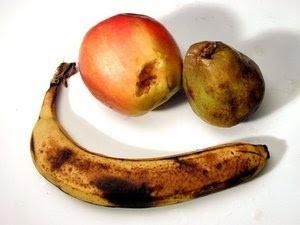
I allow blemishes and cut off rotting parts on our own homegrown food, but hate to pay for something that has a bruise on it – shame on me!

bad fruit

(Oh, except bananas – they taste better a bit bruised and make better tasting bread that way too.)

I love going to Farmer’s Markets to see all the produce others have to share.  I notice that lots of that are not perfect, but I am willing to pay a reasonable price (as long as they can tell me they did not use pesticides or chemicals) for it anyway.  I would love to see more Farmer’s Markets to choose from in the late summer/early fall months.  Our local small town grocery store allows the backyard gardeners to sell their extras in their parking lot during the harvesting season.  This is a great thing!  So why am I so picky about the stuff inside the stores?

cone of shame

Follow my blog with Bloglovin

FOR THOSE OF YOU THAT CARE, this is worth the read!

(A thought-provoking note for the first day of spring!)

It may just be because we grow naturally and love Mother Earth.

It may be just because I have an eight-year-old grandson that I would love to see grow up happy and healthy.

Then again, it may be just because!

We do not like to use pesticides.  We encourage good bugs.  Use companion planting.  Pull weeks and maintain our gardens by hand – inside and out!  It never bothered me to get down into the dirt (The ugly part is trying to get back up with fake knees – LOL), up close and personal with our plants.  I really enjoy it – yes, even pulling weeds.

Roughly 20 years ago, our local PBS station ran a program called: My Father’s Farm…this was eye-opening to me.  It was narrated by a woman recalling her childhood on the farm.  She shared how her father got sick and died early due to the pesticides (remember, the childhood was the 40’s – 60’s eras) used back then.  I remember growing up on a farm with animals and equipment to maintain the 80 acres we had.  I remember Dad mixing up stuff to go put on the fields to chase off the bugs and weeds, but I never thought twice about it because it was just what farmers did. (Note: I have tried in vain to find the old documentary – if I should come across it, I will share because it is worth watching!)  My father died at age 54 of cancer.

Now I am not blaming everything toxic for my father’s cancer.  He smoked like a chimney since he was a young teenager.  But I am sure the pesticides did not help.

PBS ran a similar story in 1996 called: My Father’s Garden…this is similar, but not as scary as the “farm” one.  It talks more about changes in farming and gardening.

Those of you that read me also know that I receive the MNN (Mother Nature Network) newsletter.  I just received this little beauty:  Roundup weed killer deemed a carcinogen, at least in California by Jenn Savedge

I am a fast reader, so it only took me about 15 minutes to read this article – however – I also had to swing out and check out the facts they list, which took me much longer.  Pretty scary findings from my point of view.  Just one more reason for my sister and I to choose no chemicals on our little piece of Earth.  Besides, I am pretty sure if our chickens went mutant, they would learn how to open doors, get into my bedroom at night, and scare the snot out of me!

scary mutant chicken  (This is sooo not right!!)

Follow my blog with Bloglovin

WHAT IS THE STORY BEHIND OUR GREENHOUSE? – Part 3

How we set up the inside of our greenhouse and why?

First, we were going to just dig in the ground – easiest right?  WRONG!  The bindweed from hell grows here.  I’m not sure you could call it growing, more like a hostile take-over!  It is aggressive, gets into everything, and doesn’t care what you say or want – it’s not going anywhere (Hostile take-over right?)!

Even with our nine months plus efforts building the greenhouse, it did not stop.  We dug three feet underground, burmed the sides and had triple insulated sidewalls all around.  But the bindweed still finds its way in.  All we knew we could do is try to slow it down or contain where it enters.

We then decided that plots were the way to go.  We are also lucky that we have a food production plant near us that gives away its drainage cloth.   We asked them about it, and they gave us the distributor.  Come to find out; it is made of the same stuff that cloth weed barrier is made of only thicker.  They use it to drain leftover water from cheese (note: eventually this bio-degrades so we will have to keep watching our weeds).  We were able to cut off massive pieces of this stuff to use on our farm.  Since it is food – there is no chemicals that are left in the cloth to do harm.  In fact, we were surprised at just how clean the cloth was.

Once the decision to use plots was settled, the idea of a whole floor weed barrier set in.  We cut off chunks of the cloth (f.y.i. this is NOT light stuff – it is very heavy) and spread them out on the floor of the greenhouse.  We used standard garden stakes to hold it all in place.  The only gaps are around the outer edge where it meets the cement wall, and where we have to overlap pieces.  When it was all done it looked great:

DSCF5135

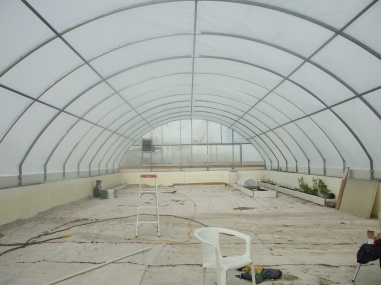
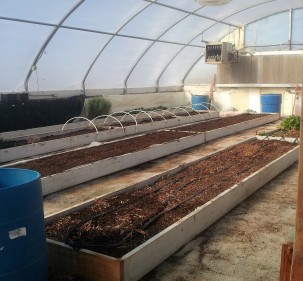
This pic also has the very first plot I put in.  It is what it looked like before we established all the north-end plots.It is on the far right against the wall.  Those are tomatoes growing in there.  This was late summer 2011.  You can see next to that plot is the start of another.  The ones against the wall are one foot wide, the others on the inside are 3 feet wide.  We left about a three- foot walkway in-between rows.  Wanted it to be big enough for carts to get through.  This picture is also fun because we are looking north and the swamp cooler is not in yet.

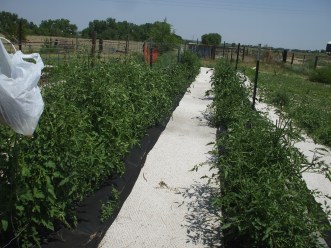
This is what it looks like now- before growing season (note the tarragon against the wall by the black cover.  There is an ever-bearing strawberry bed next to it on the right):

GH blog3 pic 2

This is what it looks like at the start growing season:

GH blog3 pic 3

This is after one month:

GH blog3 pic 4

And this is full production:

GH blog3 pic 5

There are tomatoes and peppers in with the dill.  Oh, and for all you crafters out there;  dried dill stalks make great crafting/weaving sticks – BONUS!  The top center you can see some orange mesh (It is actually used as horse fencing.  This is part of a bunch of bundles we got at the auction for about five dollars.  Works great for trellising plants.), that is where our cucumbers are going crazy.

There are Four 3’wide by 26’ long plots in the middle.  Then we have a 1’wide by 26’ long plots on both east and west sides.  All plots are made with 2’x12” painted (barn paint – non-toxic) boards with 6mil plastic lining on the inside (not bottoms) of all boards.  The plastic is the same as the greenhouse cover and is used just to keep as much moisture as possible off the board.  Our way of trying to get them to last as long as possible before needing replacement.  You can also see the weed barrier up close in this picture.  It is just a fine mesh material.

The greenhouse has been up and operating for going on seven years now.  The weeds are starting to make their way in, in some spots.  We pull what we can, and I dip the bindweed ends into vinegar in a cup.  Those of you that do not know, this is a perfect way to get to the root of the weed and kill it without killing anything else around it.  The only bummer is this is a very slow process.  The weeds move much faster than I do.

Follow my blog with Bloglovin

Just How Green Are You?

One of my fav all-around veggies is cabbage.  I am half Irish, and this is a must! (Mom would find a way to haunt me about it if I don’t!  Her side of the family has always been more fun…a bit off, but more fun!)  In honor of St. Patrick’s day, my Farmer’s Almanac newsletter sent me this winner, not like I needed any more reasons to eat cabbage, but they are interesting facts:

13 HEALTHY REASONS TO START EATING MORE CABBAGE!

Happy cabbage

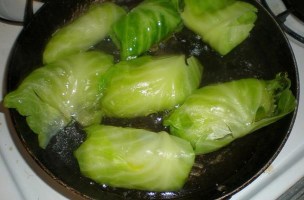
One of our favorite ways to have it is fried.  You can make cabbage pockets:

fried cabbage pockets

Which are yummy too, but we prefer just to chop it up, and go with it.  Sometimes we will do it with onions (sorry, bad pun!).

We have grown both varieties of green and purple.  Even tried growing Bok Choy, but didn’t have the same appeal to us as regular old cabbage.

purple cabbags          boc choy

Since it goes so well with corned beef (we have feasted on a couple of those already), we just can’t help but get going on our annual cabbage frenzy!  Those of you that may need a bit-O-help getting their cabbage on, the almanac also gave up a fool-proof recipe, check it out!  (F.Y.I., we always crockpot ours at least overnight before slicing.  Oh, and always make sure to cut against the grain.)

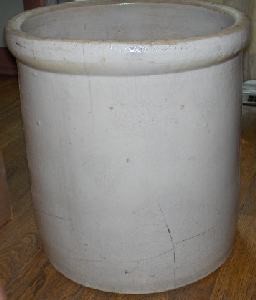
This year my sister wants to try making our own sauerkraut?  This should be interesting since we do not have anything like mom’s old canning crocks (try to find them now – WITHOUT a huge price tag on them) to let it soak in.

old canning crock

If any of you have a good modern recipe, I would love it if you would share!!

So, HAPPY ST. PATRICKS DAY to you all!  May it be filled with fun and enjoyment.  (It’s our Friday “game night” this year, so you know we will!)

st pat blessing

Follow my blog with Bloglovin

WHAT IS THE STORY BEHIND OUR GREENHOUSE? – Part 2

How and why we decided to plant the way we do in the greenhouse:

Once we knew that we wanted the greenhouse and that we wanted to make enough out of it to supplement future retirement income; we began researching different growing techniques.

HYDROPONICS

hydroponics-system

This was a fairly new fad that was popular at the time we were doing our research.  I think we got lucky when we found a place near the farm we were buying that grew tomatoes through hydroponics.  The man/owner we met informed us of his past in Agricultural Science and how he had developed a great liquid fertilizer that he used on his plants.  His tomatoes were beautiful…perfectly formed, all about the same size, smelled like a really great tomato should.  He was kind enough to give us a free half case to sample.  We thanked him for the tour of his facility and the samples and went home.

The first thing we did was review the pictures we took and discussed his set up and operations in relation to what we had in mind.  His help was immensely helpful.  Unfortunately, the taste of the tomatoes fell flat.  They had no flavor at all – bland!  We wanted to have produce that excited your taste buds from the moment it touches your lips.

To be fair, we then went to some specialty markets in the Denver-metro area and selected a variety of “hydroponic grown” tomatoes for comparison.  We found the same end results.  Yes, they were pleasing to the eye, but all flat on flavor.  That helped us to decide that hydroponics was not for us.

ORGANIC

organic-growing-system

This was something we knew a little about, mainly due to the cultural movement at the time.  Everyone wanted to go “organic” to save the planet.  Once again I began my research on it.

I knew the basics that it was grown using better methods, thus making it better for you to eat.  This was a good start, but I needed to know “how” it was grown better.  What methods were used and why?  This is what I found:

  1. A) The first thing you are going to come to is the Wikipedia definition:
    1.      Organic horticulture is the science and art of growing fruits, vegetables, flowers, or ornamental plants by following the essential principles of organic agriculture in soil building and conservation, pest management, and heirloom variety preservation.
    2. This took me to what are “essential principles of organic agriculture”, and how can I apply them? Again on Wikipedia I found this: (fyi – it’s huge, so I only took a part of the description)
    3. The principles are intended to “apply to agriculture in the broadest sense, including the way people tend soils, water, plants and animals in order to produce, prepare and distribute goods. They concern the way people interact with living landscapes, relate to one another and shape the legacy of future generations.”

2)      The four principles of organic agriculture are as follows:

(i)       The Principle of Health – Organic agriculture should sustain and enhance the health of soil, plant, animal and human as one and indivisible.

(ii)      The Principle of Ecology – Organic agriculture should be based on living ecological systems and cycles, work with them, emulate them and help sustain them.

(iii)    The Principle of Fairness – Organic agriculture should build on relationships that ensure fairness with regard to the common environment and life opportunities.

(iv)     The Principle of Care – Organic agriculture should be managed in a precautionary and responsible manner to protect the health and well being of current and future generations and the environment.

3)      This next section I found (again in Wikipedia) goes into the pest control part – the section we were (and still very much are) concerned about:

  1. a) Integrated pest management (IPM), also known as integrated pest control (IPC) is a broad-based approach that integrates practices for economic control of pests. IPM aims to suppress pest populations below the economic injury level (EIL). The UN’s Food and Agriculture Organisation defines IPM as “the careful consideration of all available pest control techniques and subsequent integration of appropriate measures that discourage the development of pest populations and keep pesticides and other interventions to levels that are economically justified and reduce or minimize risks to human health and the environment. IPM emphasizes the growth of a healthy crop with the least possible disruption to agro-ecosystems and encourages natural pest control mechanisms

4)      What # 3a) is actually talking about is how much pesticides they will allow a person/business to use on their plants – YET – still be labeled as “organic.”

We did not like the sound of this. According to the USDA (e) When the practices provided for in paragraphs (a) through (d) of this section are insufficient to prevent or control crop pests, weeds, and diseases, a biological or botanical substance or a substance included on the National List of synthetic substances allowed for use in organic crop production may be applied to prevent, suppress, or control pests, weeds, or diseases: Provided, That, the conditions for using the substance are documented in the organic system plan.

The big words that stood out in our heads were “may be applied.”  They are stating that if you have tried all of the natural, or organic, methods and you still can’t get rid of your pests; here’s a list of chemicals we do allow you to use and still use the label organic.  WHAT??!!  The Federal Regulations goes into a ton of beat-around-the-bush lingo but boils down to the fact that they do allow certain types of chemicals but only up to a certain limit (last I knew was up to 15% chemicals were allowed to be used but still called organic).  The also go on to let you know the National List of synthetic (Definition: of a substance made by chemical synthesis, especially to imitate a natural product) substances allowed.  Oh, and they also have a ton of things that are exempt from all the regulations.

THIS ALL BOILED DOWN TO ONE BIG THING: We did not want to use any chemicals – AND – we did not want to have to report to “big brother”  all the time.  If a person creates income from organic foods, in excess of $5000, they have to share all their records of operations and maintenance under allowable organic methods.  Well, our personal preference is that the US Government needs to keep their eyes on bigger matters and keep they nose out of our personal lives.  Result: no organic partying for us.

NATURAL METHODS

natural-growing-system

This became our destination!  What better idea is there for us than to go “natural?”  We do not use chemicals on any of our edibles or flowers.  The only thing we do with our lawn spaces is water and mow.  The farm birds take very good care of the fertilizer part (chickens mainly), and we compost.  If any manure needs to be added, we have plenty of friends willing to assist.

We pull weeds by hand or use weedless gardening methods (this is basically covering a plot or space with bio-degradable material like cardboard or newspaper to kill off the unwanted weeds) and companion planting with EVERYTHING!  Then good soil and compost are topped on that, then plant away on top.  It does not kill off everything forever, but it does limit growth and slows them down.) so, with proper prepping and being the Constant Gardener, we can spend more time on tending to our crops needs.

We use a TON of companion planting to repel or distract unwanted pests.  Some things we grow lure bad bugs away from our good foods, some just simply keep them at bay.  We have a great list of reading materials that I would be happy to share, for anyone that would want to learn more.  Read (and still do) all kinds of different growing methods and techniques, but I still have some favs that work best.

Next, I will share How we set up the inside of our greenhouse and why.

Follow my blog with Bloglovin

I HATE ROLLER COASTERS, DO YOU?

I hate roller coasters! I always have. I used to ride most other County Fair rides, just not coasters. The octopus (we called it the spider) with all of its spinning never bothered me. There’s just something about all the way up and way down that I never could stomach (literally – I would throw up every time I was stupid enough to try – ewe!)
I went to Las Vegas with a friend several years ago. We decided to visit Caesars Palace because the animated movie Atlantis came out and they had a ride related to it. Sounded like a great fun thing to do in Vegas – oh stupid me!
Got our tickets and while maneuvering the line to get in they handed out special glasses to view the movie with (STRIKE #1). My girlfriend picked the balcony front row seats I “So we get the best view of all the movie!” (STRIKE #2). We sat down in our front row, balcony seats and heard the announcer say “Everyone, please fasten your seatbelts so we can begin the show, thank you.” WHAT?? (STRIKE #3 and I wish I had been out!)
The movie ride started up. It was called Race to Atlantis, and I was about to find out why. With special glasses on, our seats started to tilt back. The little guy in the movie/ride was sitting in his water racer, and this HUGE slingshot thingy was being pulled back with a racer in it. At the same time, our seats tilted farther and farther back. The announcer on the screen yelled: “THEY’RE OFF!”; and like a shot, we were flung forward in our seats. Now, remember – we are front row balcony! The stupid glasses were a 3-D type, and I vaguely recall screaming as I was thrown forward in my seat! The rest of the movie was a maze of ups, downs, twists, and turns. When it was over, I thanked God several times for my seatbelt staying intact. Then I cursed at my girlfriend, who would not stop laughing at me, for taking me on such a thing!
Well, I am pretty sure all Farmers hate weather that roller coasters! This is exactly what our weather has been doing since the first of the year. The upper seventies one day to lower thirties the next – what the hay? Up and down and up and down – how are we supposed to plan around this mess? Then the other issue is, did all the bad monsters actually freeze out or are we going to have a huge pest infestation this summer?

first-lillies-2-27-17.jpg

(This pic was taken with my camera 2-27-17 at about 2 p.m.)
Most of our annual flowers are starting to pop out. The trees are starting to bud (so far only leaf buds but I am worried). We have a flood of beetles on the south side of the house, and our first house flies already!
Then this:

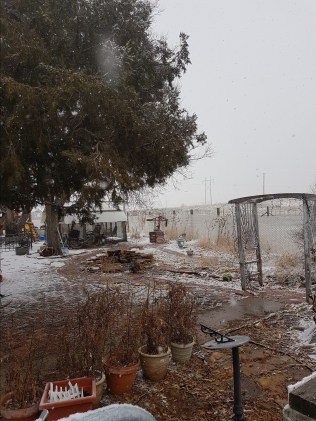
2-28-17-snowing-n-20-degrees

This pic was taken on 2-28-17 about noon. The fuzzy spot was a huge snow flake. The grey in the background is the beginning of a great snow storm.
By 5pm the whole storm thingy was over. The high never got past 20 degrees. The next 10 days are running from mid to upper 40’s to mid to upper 70’s. So, no matter how much snow we get all total, it will be gone by 5pm the next day. Now how is a body supposed to plan and plant in this stuff? Ahh the life of a farmer/gardener! The only hope is that it stays heavy/wet enough to soak in!
(P.S. Would not trade my country life for city ever again or for anything in the world!)

warm-heart

Follow my blog with Bloglovin