THE DROUGHT YEARS

 There are never really warnings when something like water resources are going to change. Oh you may see little things if you have the insight of a Native American Indian – but the average person today would not notice (ok, maybe a climatologist).

The eighties in Denver were rough economically. The nineties were flourishing and exciting. Then, at the turn of the century, all that changed. Any modern-day prophet that may have been trying to predict the future in regard to economy based on the past was blown right out of the water! The weather forecasters had the same problem.

The drought that started in 2000 (the year we bought the farm of course- August of 2000) was to last for our first 3 years on the farm. The news people all stated that it was the worst Colorado had seen in over 100 years…oh lucky us!! The first few years of the new millennium, were to be a time of major re-thinking in the way we have done and will do everything farm related! We had drawn up garden plots, planting thoughts, critter pens and the like. Well now, due to a major water shortage, we were faced with re-planning (is that a word?).

Looking back I think this was all a blessing. We spent 3 years in major drought and learned a ton-of-stuff just through our trial and error efforts! We learned the different ways to water and what worked best for our Colorado weather and soil. We learned how to do things “naturally” – meaning without the aid of chemicals. When you have farmers all around you that have to use huge machinery loaded with chemical (some organic but most not) compounds to save their crops, it very hard to go green. They would spray and by that afternoon we would be overloaded with their pests.

When you want good food that you can share with family and friends, having monster pests is not easy. We tried fencing off for rabbit control – ya, that didn’t work! The little buggers know just how to dig underneath them. So we found that wormwood was something they didn’t like – we now have it planted in a number of places – good-bye rabbits (or at least most of them)!

We also found that our house cat – Tigger – loved to catch baby bunnies – YUCK!! But it helped to control them better than the coyote’s did out here. He actually brought one back up to the house one day – and the cute little bugger was still alive? Being animal lovers (but realists – if an animal is hurting, you put it down!), we put it in a box, gave it some food and water, and waited till the next morning.

Well, we woke the next morning to an empty box? Where was the baby bunny? Tigger slept with me locked in my room for the night, so we know he had nothing to do with it. The bunny looked like death warmed over when we put it in the box, so we were sure it would be dead by morning – but he pulled a magic act and disappeared! We searched everywhere and no rabbit. To this date, never found that baby bunny (think that is where gremlins or angels stepped in).

Our first drought year also forced us to make some hard choices. We purchased cashmere goats and angora rabbits so that we could sell the fibers, not the animals.

Well, cashmere goats only get combed every spring, 1-time a year. Angora rabbits are very VERY high maintenance! They were constantly getting their hair matted and tangled so they needed to be cleaned and brushed almost everyday. When you both work off the farm to keep the finances going, then are trying to save a garden so that you will have food to put by, spending tons of time on critters that are a hassle is not feasible. The rabbits were the first to go.

We knew our goats would bring an income, although very meager, within 5 months. Since that is how often they birth, and it only takes a couple months after that to sell off the extras (usually males) that we couldn’t use-no worries, they are keepers. They at least provided enough extra income back then to assist with their feed and mineral supports.

The gardens seemed to be a constant struggle also. We found that when you have a drought, every weed in the territory will appear. The cacti went into hiding, but the goat-head stickers were in abundance! The bindweed also found was a thing that can get out of control in a heartbeat. After a lot of trial-and-error, we found out that our ducks and geese loved goat-head flowers. If you can get them into the area when they are in flower stage, they will eat them thus creating no stickers – yea! The bindweed took a little more trials (with a lot of errors) and tons of talking with locals and referring to our books (yep, we have a huge pile of all kinds of gardening books).

Turned out our best defense came from a natural method – vinegar! Of all things – vinegar- who would have thought? I know it was good for a great number of things, but when used straight, and extremely carefully, it will kill off just about any plant –including bindweed. The tricky part is you have to use a closed container (just a small one so that if you accidentally knock it over, you wont spill on something you want to keep – yes, I did that and killed off one of my best pepper plants) and a sponge. Semi-soak the sponge and wipe it on the bindweed leaves. Works perfect!

We found that it did not work on the goat-head weed though. Apparently it only works on the bigger leaf plants. We also use it to kill of the grass/weeds that pop up between our bricks in the patio – just don’t get it close to trees, flowers or bushes you want to keep.

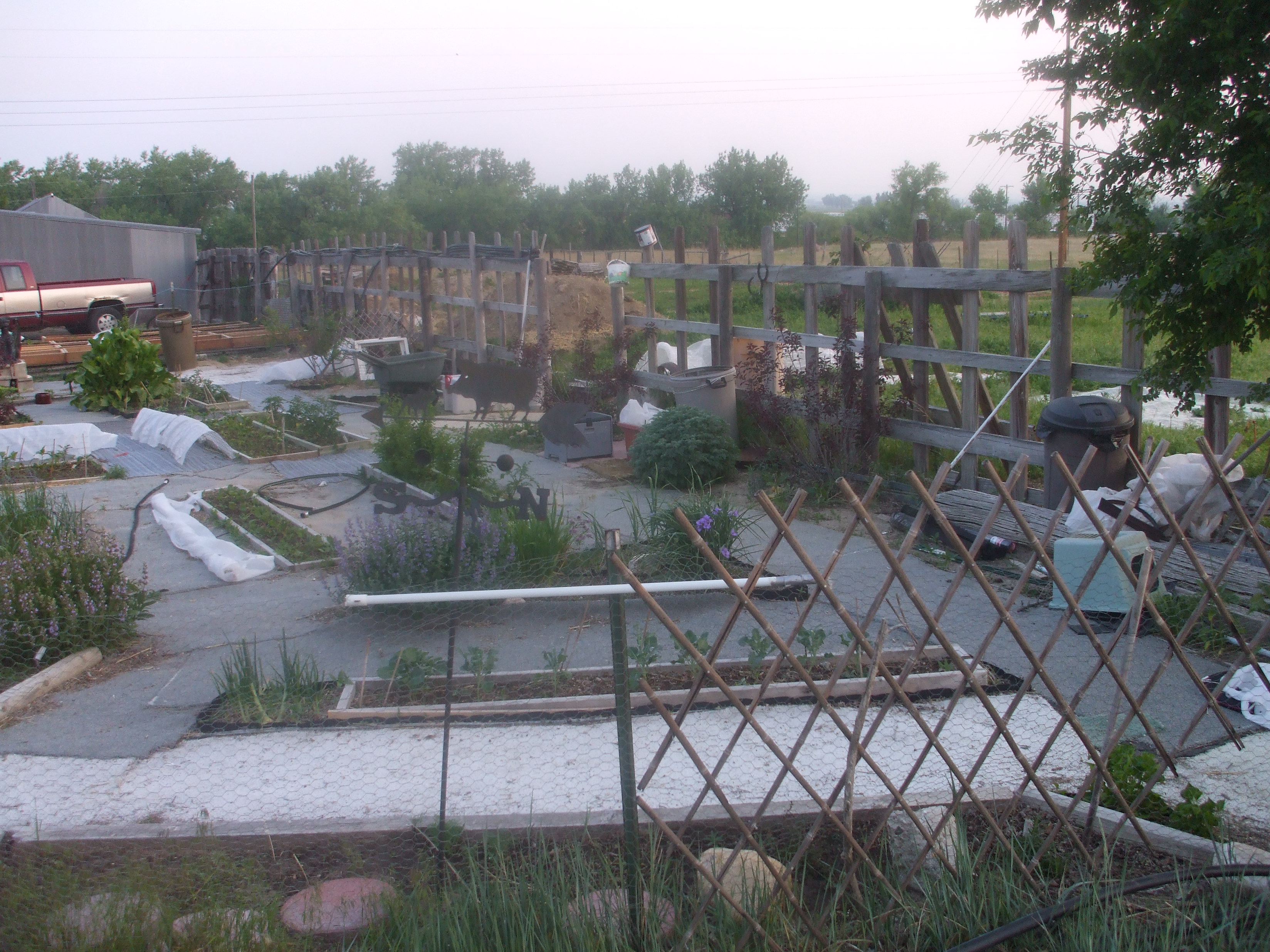
The drought years taught us how to grow in long rows for minimal flooding purposes and in plots to limit the area of weeding. The one thing we didn’t learn until much later is what to do with the walkways between the plots and rows. We tried tilling – nope. Tried lying down weed barrier cloths – nope. Tried letting things grow up and then mowing them before they could produce flowers or get to long – nope. Nothing we did seemed to work. We even tried the newspaper plans. Ended up with newspapers and straw mulch flying all over our property and across the road.

Oh, did I mention we have almost non-stop winds out here? That is unless its about 100 degrees out, then we have no wind. We also have high altitude issues. Not like living in Denver or the Rockies height, but just enough to make things challenging. I couldn’t contain my raspberries in Denver, but can’t get them to grow out here? Found out that our heat is so intense (from the high altitude) that they need partial shade to grow.

Hmm, was never that way when we were kids in Wisconsin. We had about a 30×30 foot plot of them as kids, and loved to attack them in season! Our gardens now look like something out of a magazine. To see them from a distance looks beautiful! Nice clean plots with, what looks like, a colorful cement walkway. Surprise – its not cement! Cement for all of our garden space would not be very cost efficient.

Another one of our trial and errors was actually a happy “light bulb” moment. I use a piece of old carpet or rug to sit on while I weed (saves my butt from stickers). So, about 5 years after the drought it finally dawned on me – old carpet! We started it couple of years ago. Lay down a heavier duty weed barrier (not the least expensive stuff – feel it before you buy-you can tell it’s a heavier duty cloth), place your carpet sections over top then use garden stakes to hold it all down (we use the “U” shaped ones – also works best for hold connecting pieces together).

When the carpet, or a piece of it gets too worn out from the elements, simply cut that section off and throw it away. Then replace it with a new setup – works fantastic! Now the only weeds we have to contend with are in the plots and periodically on the edges! Saves a ton of time and effort and, I am thrilled to say, has found a way to repurpose old carpets.

My previous job of 10 years was with the local government housing authority office. Through that I made a lot of landlord connections. They were always complaining about having to rip up tenant damaged carpets on carpets that were not that old (if there is a bad tear or burn in the center of one – the whole thing usually comes out), then having to pay extra to have the trash people (city things) haul it off.

Well, I made a deal with a couple of them – if they would cut the carpet into 3-foot widths (or less) then I would take it off their hands for free! They love the idea and to this day I still get pieces nicely rolled up and left at our gate. There is nothing in the carpet that is toxic (or they couldn’t put it near children in apartments – think about it!), why let it bio-degrade in a landfill for years when we can get a second life out of it! By the time we are done with it, there is not much left to dissolve. Most of it is pretty well shredded when the weather, heat and our bodies have left their marks.

That was another thing we learned from the drought years – how to recycle, reuse, and/or repurpose almost everything. We are very proud of that fact. Think our parents would be also-if they were still alive.

Our parents were raised during the depression years, so saving everything for a possible later use became second nature to them-especially our mother. She carried that with her all through her life and I am very glad of that! Some nights when my sister Darcy and I are having our “in our cups” moment (a phrase picked up from our mothers sister Marlene – thanx Marlene! – oh, and it means having a few drinks at the end of a hard work week), we come up with the best re-purposed ideas! The only sad part it that our ideas take so long to appear. We almost always say, “I wish I would have thought of that one X years ago when we were working on…!”

Never fails to amaze me how “out-of-the-box” our thoughts get once we have time to relax and let our minds wander. And I love the moments when my mind wanders and I go with it, however I don’t get anything done here during those moments! So I believe the moral behind this is that no matter how bad things seem to be, there is always a reason for everything – this is my life motto now, and I really do believe it! Not a bad thing seems to go by that I don’t (sooner or later) see that there was a reason for it. Usually a good life lesson!
Y-KNOT FARM-THE 1ST YEAR

Always best to sleep in something!

We took pictures of the whole place!  We were so proud and happy to be there, and we saw such potential for our dreams to come true!  We have never been afraid to do a little hard labor, after all, we grew up on 80 acres in Wisconsin – how hard could this less than 20 acres be – IDIOTS!  We were also 20+ years younger then and no matter how many times I tell myself “you are only as old as you feel” or “age is a matter of mind – if you don’t mind, it doesn’t matter”, reality slaps me in the face! Actually, it usually slaps me square in the middle of my lower back, or sometimes my knees, once in a while my shoulders etc.etc.etc..

I still find it funny how I took my adolescent body for granted and now life is demanding payment for all my transgressions as a child.  Payment in the form of – remember that time you fell off the horse riding backwards, well here’s the damage you did to that knee now –  payment please – OUCH!   However, even with all of the aches and pains of growing older, I very much appreciate our little farm! 

Back to the story…in August of 2000 we sold both of our houses and bought the farm.  The first thing we did was purchase 3 goats – cashmere of course- non-edible.  Well, you can eat them since a good cashmere breed will be cross with a good meat goat in the breeding (excellent for meat they are), however, our plans were to not have to kill to obtain an income.  So, cashmeres for their fiber/hair it was! 

We had thought that through also prior to purchase.  We contacted a world-renowned breeder who just so happened to live in northern Colorado and had a huge flock just across the Wyoming boarder outside of Laramie.  Chris was her name and she was very knowledgeable!

We contacted her in the spring of 2000, which turned out to be perfect timing!  It was time for the annual herd checkup.  Every spring she brings in her 1000+ head of goats and then wrangles them up for shots and hoof trimming.  I didn’t say “line” them up, (even though we had to get them into a line) because you cant get goats to “line up”- especially when they have been semi-wild running around a huge section of Wyoming territory.  They will run from you, run over you, run over each other, run over the fences and basically just run! 

Chris brought in the herd to a huge holding pen, then we worked with her to separate about 20-50 at a time.  This smaller group was then maneuvered into a large shed/barn building which she had installed a number of shoots.  These shoots started out large, then grew smaller and smaller as they were moved to the front of the building.  Once at the head of the class, the goat was then grabbed by the horns and dragged to a hitching rack.  Don’t confuse this with a hitching post!  A post is where a tame animal can be gently tied until you are in need of it again.  The rack is just that – it has a platform on the bottom(ground), a long metal pole with a “V” welded on to it (looks like a very large “Y” altogether).  There is a semi-heavy chain hanging from the “V”.  The goat is dragged (usually screaming – scared us more than them I think!) to the platform, chin placed on the “V” then the chain is placed over the top of the head behind the horns and locked in on the other side of the “V”.  Once the goat’s head cannot move they, for the most part, settled down (except for the occasional “twister” that would scare us to death!).  Chris showed us how to administer shots and trim feet. 

Since these were cashmeres, we were also “combing” them.  Combing is similar to shearing of a sheep, however; you don’t shear to get fiber.  All goats have 2 kinds of hair.  Once is very strong, stiff and straight as a board.  These are called “guard” hairs.  Then underneath that guard hair is the “fiber”.  This is the downy soft, kinky pieces that the cashmere yarns are made of.  The kinky part is what is most important!  It is called “the crimp”.  The more crimp (kink) in the strand, the better fiber it is, thus making the better/softer sweaters.  So that is your Farming For Idiots lesson 101 – goat fiber.  Just one of many insightful things we have picked up since starting this endeavour!

It actually turned out to be one of the smartest things we did do!  We had never worked with goats before (Wisconsin was beef cattle, horses, rabbits, pigs – no sheep or goats.) and before you undertake any new “huge” life changing project, I strongly recommend  a “test run” if you can get it!  This was a great test run for us.  We fell in love with the goats (even with all the bumps and bruises from our goat wrestling day) and the small herd we started with had been raised more as family pets – perfect! 

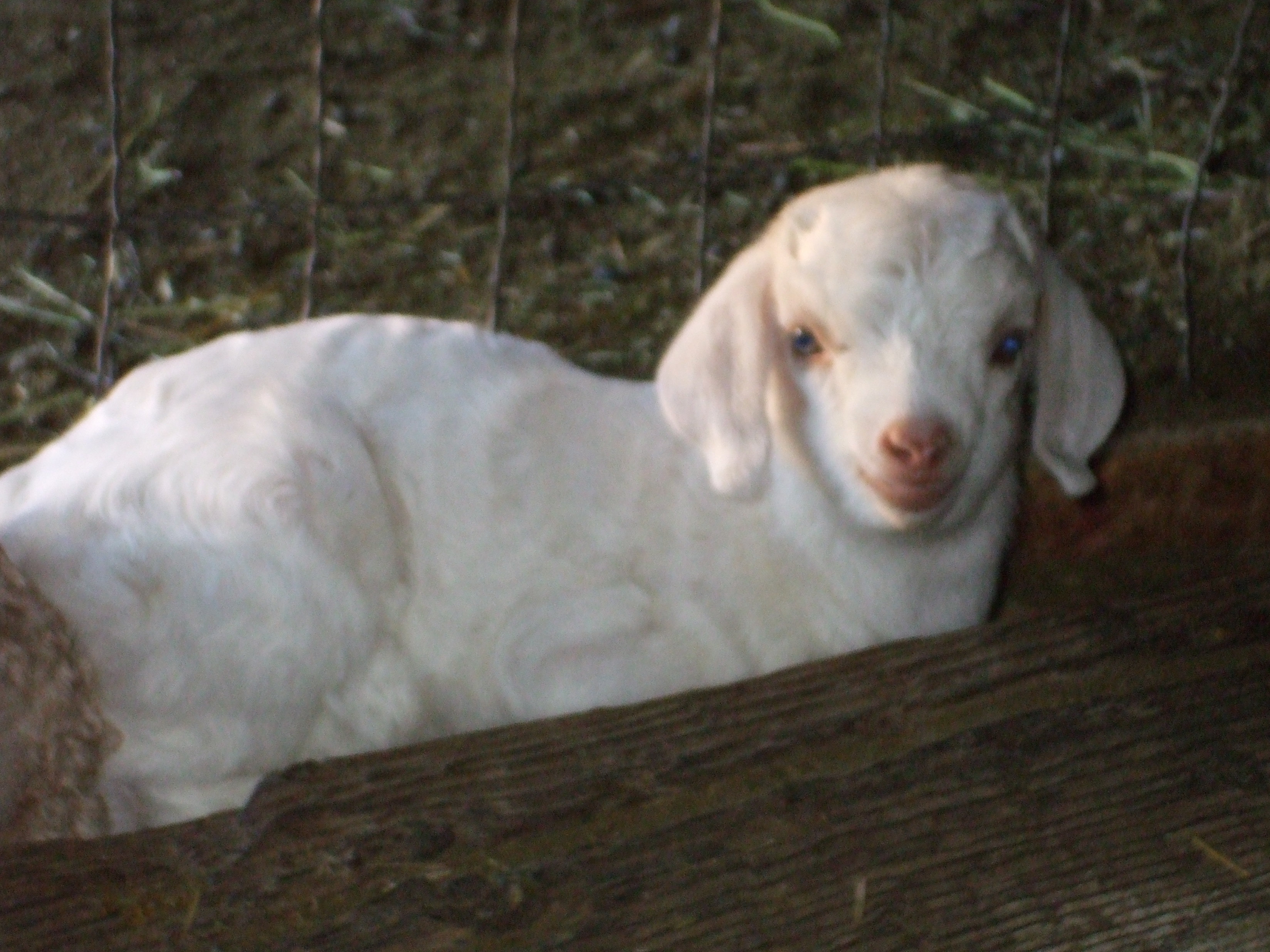
So, a day of testing turned into our first flock of goats – 12 in all.  Freaked out the neighborhood!  All the goat farmers out here had milk goats, Nubian mainly.  A very friendly goat, usually spotted with long floppy ears.  We pop up with a herd all black with 3 white (not spotted – full color) and with long hair hanging from their bodies – what were we thinking?  We had tons of people just pulling in our driveway to find out what they were. 

The other shocker for our community was that the extras we had after birthing, were being sold locally for “meat” – SHOCKING (note: we already broke our 1strule – wanting to raise things that did not have to be killed)!!  Even the milk goats here are more like family than animals.  The funny thing is, when a local farmer had too many he would take them to auction for a little extra money.  We truly believe that they either didn’t know or turned a blind-eye to the fact of what “auction” really meant.  Where do you think they go from there-hmm?  Most went to food! 

A couple of years later we found out that a woman comes in from California once a month to our local animal auction house, and purchases hundreds of goats that are then shipped out of the U.S. to feed people in other countries – amazing!  Now that we have had so many refugees move into the state, almost every goat farmer has switched from just milk goats to milk AND meat goats – so my thinking is, we were actually ahead of the crowd in this merging market and it was great planning on our part (planning? Hmmm? More like huge happy accident.)!  The downside to this wonderful planning was that the price per pound went way down on goats since they were being reproduced in such abundance.  A single female can produce 2 times a year, twins and triplets are not unusual, and best to eat at about 5 months old.  Very different from cattle that take years to get to eating size, so they are much more profitable.  Oh, and a goat will eat just about anything – safe guard your trees and gardens cuz they are sneakier than pigs (that’s another story).

Unusual Partners or Pre-Farm Prepping

I shared my idea of returning to farm life with my sister Darcy.  The original idea was to build something for retirement.  Even back then I was not real sure our government was going to have money left in social security by the time I would need it.  The thought was to be able to produce enough for us, family and friends – and then sell the extra to maintain the farm life. 

Somewhere deep in our subconscious is still “the farm” and all its ways and means of being.  Our project was to dig all that out again and put it to use.  We had no clue where to start so we made a list (I’m great at making lists!).  What were ALL the things we would “like” to have on our farm, and what were the things we “had to have” on our farm?  That was how we began.  The list was very long at first (couple of pages-but there were also plans in there for future use/ideas), and we broke it down to the basics. The following is our original list:

1.      Must have water – pond, creek, river – whatever, as long as it was on our property or ran through it.

2.      Must have animals – something that we would not have to kill to make a living off of (Looking back now – this was a “dream” idea!).Must have decent soil to grow our own food in.  (This is also where we decided to buy a greenhouse – original idea: for our own use first, family/friends second, then sell any extras to locals.)

3.      Things we would “like” to have, but don’t necessarily have to have:

a.       A fireplace. (A backup heat source is always a good thing!)

b.      Outbuildings. (Always easier to start a farm if there are structures already on the property – may need some repair work, but that’s ok!).

4.      Trees. (This may seem silly but, since we grew up in Wisconsin, this was a must since it’s a childhood thing for us!)

Isn’t it funny how you can, at 40+ years old, still have big dreams?  We sure had ours!  We were lucky enough to find a good Real Estate Agent, who was more than happy to help us on our trek.  Brian was his name, and we went to him every weekend to pickup a new MLS sheet (its their multi-listing of places for sale).  We would pack drinks in a cooler, munchies for the road and take off.  My daughter usually stayed with friends, but sometimes she would go with us.  We would just start driving to all the spots he had on the list.

We got really good at reading Realtor-speak…Open Floor Plan – meant there was a huge hole in the roof, or no roof at all.  Scenic View – meant you were out in the middle of no-where and the nearest store, town or neighbor was about 5+ miles away.  And our favorite…Several Out Buildings…this one became our major source of great joy on our excursions, as it meant “several port-o-potties” either lined up in a row (yes, we actually did find this up in the middle of no-where in the Colorado mountains) or scattered about the property.  Once in a while it actually meant derailed train boxcars (yep – they use those a lot out here for anything from storage units, to a barn for your goats), but usually it was the port-o-potties.

One of our trips took us up to Peetz, Colorado.  It is way up in the northeast corner of the state, very close to the Nebraska boarder.  If you have never been there, but want to see some very beautiful “old west type” countryside – check it out!  The plateaus are outstanding and there are only about 10 buildings in the whole town.  One bar, one post office and I think there was a quickie-mart of some kind?  I vaguely remember seeing a gas pump, but I don’t remember if it even worked so I suggest filling up before you go out that way.  I know for a fact there is nothing else until you get to Sterling or the Nebraska line.

We never did find the place listed on the MLS sheet but, since it was a beautiful day, we decided to take an alternate route back to Denver.  We had driven straight out from Denver on highway 76 to Sterling, then went straight north to Peetz.  We revisited the map, on the way back, and saw that a more scenic route would be to take highway 6 from Sterling to a little town called Brush.  Here we could then pickup highway 76 again and get back to the city.  Highway 6 also followed along the Platte River so we thought it would be a nice drive for us Wisconsiner’s.

 It was a beautiful drive.  We passed through several small towns, one even has a home for a carnival business.  We picked up some squash and fresh sweet corn at a local farmers home (They had a sign out front – you just drive up, pick out what you want from their stand, put the money in a jar and leave – no sales people to haggle with.  No people at all – love that feeling of rural trust!) and continued our drive.

 Just as we came up on the highway 76 intersection, we spotted it!  A for sale sign!  We turned the car around and drove back and forth in front of it several times.  Could we tell the property line?  Was that pond in the back included?  Is that creek running through it?  What about those trees in the back?  And it even had several “real” outbuildings – not port-o-potties – yea!! 

This was it!  The place we were looking for!  Then began the fun process of arguing with mortgage lenders.  Funny how they consider you a risk just because you are moving 2 hours away from your job!   Oh, and really considering quitting your job to work on the farm, or at least be nearer to your home.  Apparently Lenders are fussy like that!?!  Well, after about 3 months of “we need more documents” from the Lender – we finally closed on our little piece of heaven!

Roughly 20 acres(17.9 split into 2 sections), a pond (when it feels like it), a creek (when the county farmers are not irrigating off of it), several real outbuildings (not port-o-potties) including 2 nice small barns (a vanishing breed), plenty of growing space (once the rope horse training pen is amended), and a house with a fireplace (not used in a decade)!  Yep, this was now our home!  Welcome to the 1st year of the worst drought Colorado had seen in over 100 years – perfect time to buy a farm!?!


Where the urge came from.

Growing up on an 80-acre farm in Wisconsin was a hoot!  I remember the smells, the sights, the sounds, the work and the fun of it all.  Even bailing hay did not seem like a chore because my parents made a party out of it every year.  Family and friends would come from all around (people they knew from working in Milwaukee and I had no clue who half of them were) to come to the Helberg’s cuz its time to bale hay – wooo hooo!  Sounds silly now, but back then it was a big deal.

Hundreds of people, BBQ grilling, refreshments and yes, we did actually bale hay.  Back then there were no huge round bales – no huge bales at all.  Every bale was handled by hand.  Still amazes me that people actually came out to do this physical labor with/for us? They did, and in flocks!  Whole family in tow.

Then, every fall, was our corn roast and each year the number of people that appeared was larger than the last.  All I knew, as a child, was that it was a lot of prep work.  Get the tractor filled with gas and hooked to a flat bed trailer loaded with hay for the rides later.   Get out to the mechanically fresh picked cornfield and gathering all the ones the mechanical pickers missed.  Bring the corn up to the back yard and load it into the cleaned horse tank.  Cover it all with ice water because that keeps the corn firm and crisp until time to BBQ.  Cleaning the house, open the barn (where all that fresh baled hay was so kids can play up there and out of parents hair for the day), saddle ALL the horses and be prepared to lead them around with greenhorns on their backs all day.  Every year some idiot would think they could ride alone and fall off or lose something.  But this was all in great fun and what a fantastic way to raise children!  How smart my parents were!

Well, it was at least 30 years since those days, yet I could (and can do even now) still smell the fresh hay almost every day – even in winter.  I couldn’t  drive past a fresh mowed field or even fresh mown a lawn without wonderful memories flooding back into my head.  So, at age 41, my sister Darcy and I bought a farm.  Not in Wisconsin, but in Colorado.  We left farm life when I was 13, moved around with the folks a bit, ended up in Denver for the 20 years prior to my 41st birthday – so going back to the farm was going to be interesting.

I was a single mom with a grade school age daughter when the Columbine tragedy happened.  I took that as my sign – time to get my daughter out of Denver!  She and I had talked for years before this about getting back to a farm like I grew up on.  She told me that she wanted one of every animal she when we get that farm, so it kept her excited about the idea. 

It’s a horrible thing when schools become as dangerous as Columbine, and all I knew is I was not going to let my daughter be a statistic.  Denver was a great place as a young adult to live – lots of things to do, but not good for my child any more.  So the search was on!