WHAT IS THAT OLD MOON UP TO NOW?

I’m throwing out this bit-o-post just because I wanted to share some happy thoughts.  I just went through how I love fall and why, well this Sunday night 9/27/15 is another great reason.  You may have heard or seen this on the news, if not here it is…

A SUPER – HARVEST – BLOOD – TOTAL SOLAR ECLIPSE MOON

How cool is this?  The super moon alone is fun to see but to have all of this on one night – wow!  We have seen a number of harvest and blood moons here in Colorado.  The best time we catch them is just as they are rising.  I was also freaked out by a super moon while driving to Cheyenne, Wyoming one evening – thought someone built a huge satellite dish out on the plains – ha ha, nope – just the super moon coming up.

We don’t get to see much of the northern lights down here, but when it comes to falling stars, super moons, and a great night light show – that’s all ours!  Nothing blocking our view unless the occasional storm is passing through.  It is supposed to be clear sailing here Sunday night – hope it will be by you too!

Oh, and just a tidbit for my gardener fans…the flower that is attached to this blog is a “moon” flower.  The flower is about the size of a softball, and only blooms at night – really cool!  Another unique beauty of nature to think about on this super moon weekend!  We had them here once, hope to have them again next year.

Happy mooning!moon flower

PUTTIN ON THE ROOF


BEFORE

Well, October 22, 2011 and the day has finally come – putting on the roof! We worked so hard all spring/summer long and in 100+ degree heat to get to this day. Cant tell you the excitement I had!

Now the downside, it had to be an extremely calm day to do this part. Out here in northeastern Colorado those are few to come by. Early morning is usually our best chance to get little to no wind. So we decided that this Saturday morning of October 22nd would be a great time to give the lift a chance.
We had asked many of our friends to come help. There are 15 rafters on this puppy so we would need at least that many people (preferably double that on each side) to handle this project. One person on either side at about every 2 rafters should be able to hold the double plastic wall going up. Then, once up, everyone has to hold it in place while another person (in our case it was Keith – he is not so afraid of heights) goes up a ladder, starts at the center top of one end and pounds(and of course it does not just “snap” in with your fingers – NOOOO, you have to wack on the clips several times to get them to lock in the double poly-ply.) the clips in their track to hold the covers.

We ended up with 8 people – thank God there was no wind when we started!! We didn’t pull out the rolled plastic until this day of installation – afraid it would have blown to the next county the day before! It’s not uncommon for us to get 10-15mph winds, but this last summer we have had several at 20+mph and even a couple at 35+mph. When it blows that hard we usually have to spend the next couple days putting our barn/shed roofs back together. One day it was so strong that it somehow managed to blow out one of our shed windows – from the inside?! Now that was freaky! So, our first job was to open and roll out one sheet, then open, line up and roll out the other on top of it.
We thought about this a lot in the week prior to this day. Take up one at a time both at once? How do we raise it/them up and over the rafters? What if they get stuck up there? Should we have the scaffolding on the inside ready to go if that does happen? We went through a bunch of scenarios and even asked a few local plant grower greenhouse friends what they do. We were lucky there cuz one recently (in one of our great wind storms) had to do just this thing – “ropes and just pull” was their answer, oh and “make sure you have enough people” was their helpful hint. Too bad this hint didn’t help us, we were very short handed.

Well, we decided to do both at one time, and we purchased a bunch of plumbing 1-1/2” PVC pipe. We duct-taped both sheets to the pipe, with just hand forcing the pipe pieces together – no glue. We also ran a 100’ rope through the pipe as we put it on. The rope was long enough to sick out both ends, so we were able to tie another long rope to each end. We then cut a small hole in the middle to tie another rope around the center. With only 3 people on the opposite side to handle the front, middle and far end – we pulled!! As the 3 people pulled, the others on the start side watched to make sure it didn’t fold or catch in a wrong place – we got really lucky cuz it just lifted right up and over!! YEA!!!
Once up, it took us about a half an hour to figure out if it was squared (pull this way a bit more, nope, pull it back that way – just a bit – ha ha). Once we were sure it was a squared off as we could get, Keith quickly got up on the south end center and started hammering down the brackets into the tracks (rubber hammer of course – don’t want to damage a track or you are really screwed). After that was all secured – he started on the north end top center. That was when the wind decided to show up! Pretty sure that Mr. Wind decided that it was time to have some fun with us, and didn’t just grab both layers to keep it even and straight – nope, he had to sneak in between the layers and really screw with us! (oh, and of course the wind is a “he” – all the guys I know love to rip stuff apart, but are never around to put it back together – extra giggles on this one!!!).

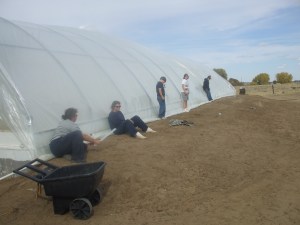
When we had several places tacked down on the south, north, and east I asked our friend Carrie to get some pictures. Check out under our butts and what the kids are standing on…its rolled up plastic and by the wheelbarrow you can see the pipe sticking out on from it on the ground. The plastics were larger than our structure by quite a bit – thank God again!! The hung over the north and south ends by at least 2 feet (you can see the corner south end where I am sitting.), and along each side by at least 4-5 feet – this was a very VERY good thing since it was now about 9:30 and the wind was kicking up good. Tacking it all down took much longer than we thought. So glad Carrie was there cuz she would run to the house and get drinks for all of us and snacks for the kids (yep – had 5 grandkids there to help – 2 were mine and a bit small for the job, the 3 of Keith’s were fantastic and a HUGE help!!) – you can see how bored the poor things were just standing on the sheets. Took us till noon (I remember cuz we ordered pizza’s for everyone!) to finally get it all tacked down. We had a couple of wrinkles, but we could work on those at a later date. For now, it looked pretty darn good to us and going inside was amazing!

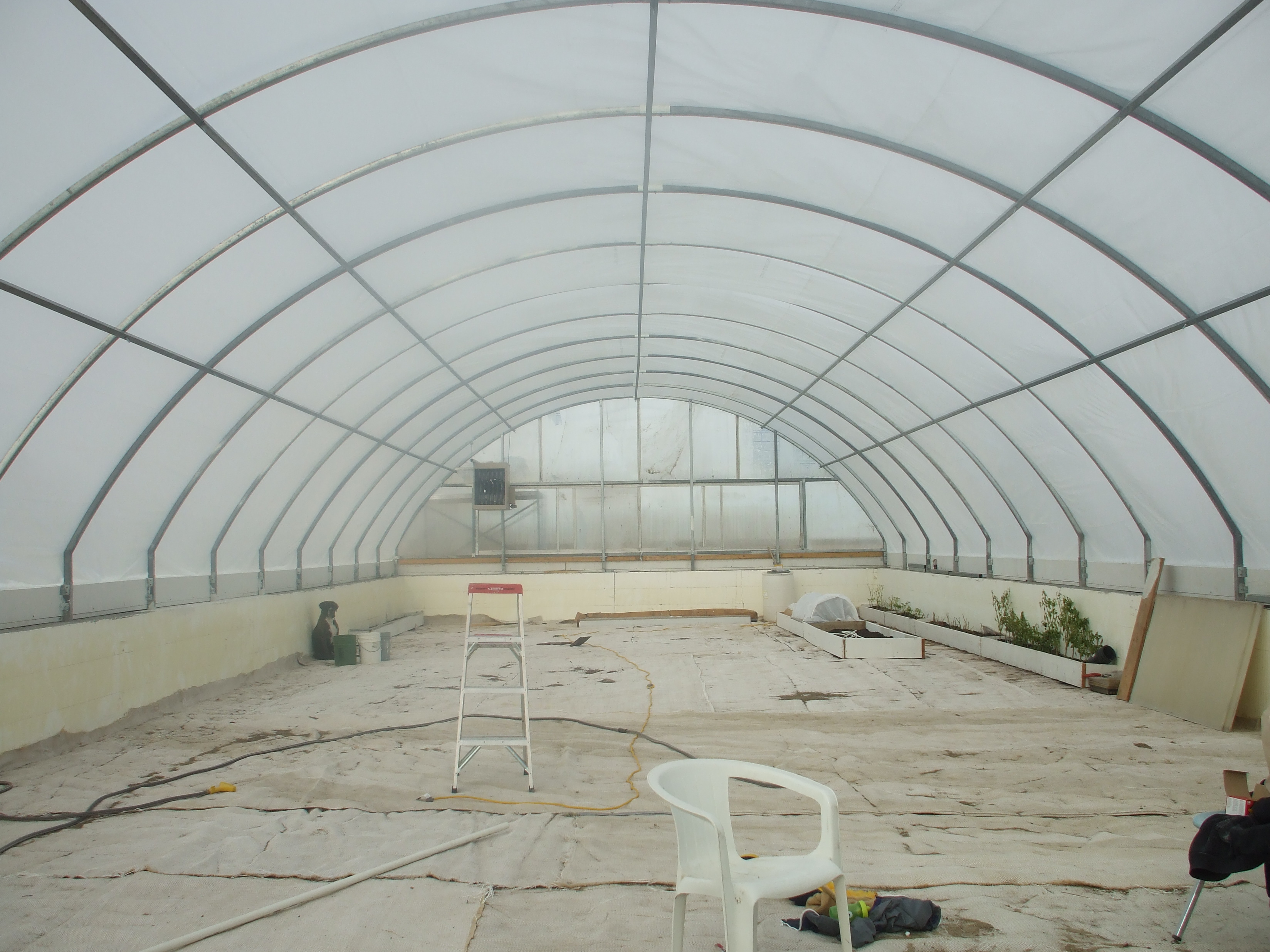
I have been in a lot of greenhouses over the years, but it’s a very different animal when you are building it yourself. We have to step down 2 steps to get into it and to look down the length with the covering on is a real sense of accomplishment!! I will never forget 2011 and doing this project, and I have the scars to prove it!


It was a cooler day and the first one to notice that it was warmer inside the structure was our dog – she’s in the center of the picture against the left side wall.

END WALLS FANS AND HEATERS

It all looks so clean and pretty for the moment.  I even found time to slip in the first plots (look to the upper right in this picture).  They don’t look like much from this angle – but it was very exciting to see them there.  Made my heart warm to know that all the bloody knuckles, sun burnt shoulders and joint pains were not in vain – this was really happening!

 This view is to the north (where the swamp cooler will be) and the final part of the triple insulated wall is filled in with metal framing for the wall all set in place – time to build the ends!

The ends are just huge sheets of plastic.  Didn’t sound like a tough thing to do – oh silly me!  We propped them up against the metal skeleton and then just used a marker to line up where to cut – piece of cake.  Now the cutting was a whole different animal!  This picture angle, it just looks like thick sheets of single layer plastic – nope. If you have ever looked at hard plastic on a greenhouse at your local garden center, you would see that there are pockets in that plastic. Not sure why they make it this way?  Could be for drainage?  The pockets would allow the moisture that could build up to flow through them to the base and drain out – but they are on the outside and the tops are all covered with a metal cap (and eventually the roof plastic covering and another metal cap), so there is no way for any water to get into the pockets.  I still have no clue why they use this type of plastic, all I know is that it’s nasty to cut!

 Cutting a straight line was great-just follow one of the pockets and you can do it with any box-cutter knife.  Cutting the curved lines was ugly!  First we tried to use a jigsaw.  Well the first attempts on that was a disaster until we figured out what we had to prop 2×4 boards on either side of the cutting line and then hold the plastic down really tight.  I did get a great laugh on one of the first tries when all I was doing was waving the plastic up and down with the saw blade.  Darn stuff is so light and flexible that the blade just carried it – didn’t cut it at all.  Second attempt made it splinter, not a clean cut and really not good to have anywhere near the plastic roof material.  But by the third attempt and with the help of some 2×4 wood pieces and a bit of extra weight – got it done!

 Once the plastic was up, the large fans could go in.  Oh, and these were in pieces and had to be put together before they could be hung.  Nice huh?! 

They have to sit at an angle so any moisture or debris that builds up in them can flow off.  The next picture shows their size in comparison to the door – THEY ARE HUGE!  The fans are fairly heavy because they are so large, but the flimsy sheet metal that incased them is what got to me!  First we had to screw the metal casing to the big fan frame – ya sure, try to align all the pre-drilled holes when the whole thing keeps moving.  Made me think of a hula-hoop…the more you moved, the more it moved!  Lost track of the number of cuts I got on those suckers!  The funny thing about a sheet metal cut – it’s so clean, it never wants to heal, but hurts like crazy! 

We didn’t have much room between the greenhouse wall where the fans needed to go and the shop – only about 10 feet.  We did manage to put the fans together, then lift them using the bobcat and coming in at an angle.  Once Keith had the bobcat close to the hole for the fan, it was my job to push it into the hole and get it screwed to the frame.  No pre-drilled holes in the frame by the way!  My arms got a major workout those days Punching into the framing was always an adventure.  Drill starter hole first, then put all the pressure you can on the metal screw to push it through and hold the pieces – spaghetti arms by end of day-YEA!

 Good thing there were only 2 fans!

The door is normal size – about 7 feet.  The fans are about 4 feet tall and 4 feet wide – I could barely reach across in any direction to hold the darn things in place – but we got them up!  One minor problem…when we pulled out one of the motors to see how it mounted, we found we had installed the fans upside down!?!  Got great laughs from that one!  Struggled with the darn things for several days only to find (after the fact) that we did great – just upside down!  Too funny!  When we set up the fins (one big piece, light to hold/carry but awkward to maneuver), which direct airflow, they ran right into the motor – won’t open!

That was easily remedied, and no we didn’t take them out and turn them around.  The more we thought about it, the more we liked the way they were.  The plans called for the motor to be hung from the top.  The motors are not light!  If/when we will ever have to replace a motor, why would you want to have it at the top?  I’m not a “spring chicken” any more and trying to hold up a 50lb motor over my head and screw it up there did not sound like something I wanted to look forward to in the future.  So, our mistake became a blessing – we put the motor on the bottom and just built up an extension on the inside to accommodate the fins.  Viola!  Functional fans!

The north end looked easy enough – oh silly me again!  We had the cutting/shaping down to a fine art, but this end had to accommodate an opening and one really huge flap/door!  The swamp cooler is roughly 20 feet long and 4 feet high – HUGE!  Nothing like the ones you see on houses or mobile homes.  Those are only about 2×2 feet with everything already installed.  Our swamp cooler is in pieces and will have to be installed piece-by-piece, including the flap/cover on the backside to block out the air/wind.  This would all be set up later, but now we had to hang the flap, which was just a huge metal frame. It was just like a monstrous picture frame but much more flimsy.  Once that was in place we had to cut and attach the plastic.  The best part was the pieces of plastic for this were straight square cuts – wooo hooo!  No angles – yea!  (FYI – several months later, after the roof was up but the swamp cooler was not yet, it became very hot in the greenhouse.  I thought I would be smart and prop some 2×4 boards to hold the flap open and get some airflow in there.  Well, stupid me lifted the flap too high and the whole darn thing dropped right out of its track and on the ground!  First scared me to death – 20’x4’ metal/plastic floppy thingy falling on me-eeek!!!  Then I just stood there and laughed!  Was easy enough to pop it out – great thing to know – but just try to put it back on alone – NOT A CHANCE!  Just had to laugh at myself!  Got my sister Darcy to help me put it back up when she got home that night.  That was great fun cuz we could not stop laughing – it was just so floppy and trying to align the top of the flap track into the wall track was a challenge – but we did it!!)

When all was said and done, I stepped back and took the next picture – a real building was starting to form – soooo proud!

One last little note on this phase of construction…the heaters were easier to hang than the huge fans!  The end wall was still open and the bobcat held up the fans while we screwed them into place.  With the huge fans, it was more human strength than bobcat.  Never thought I’d have arms like a body builder – but this sure put me to the test-ouch!

CLEAN UP, ENDS AND FLOORING

Cement hardened just fine but there was still some prep work to do before the roof could go up.  All the insulation (remember I told you it was like leggos?) had these little nubs-like things on the top.  So I had to cut/pop them all off all the way around.  If they popped off that was great – unfortunately most had to be cut or trimmed off.  My razor knife worked best for the job but played hell on my fingers, especially my knuckles!  Took about 3 days to get it all scrapped off and as smooth as possible.

 Once the cement top was cleaned (yep – actually used a small whisk broom and soapy water rag to get it all pretty!) it was time to seal it from the weather.  Took about another 5 days to get it all painted with a water sealant – the complete exterior and top.   We will be burming the sidewalls (burying them under dirt) but they still needed to have the sealant applied.  This will help them stay protected against the moisture accumulated in the ground that will be pushed up against them.  A small part of the wall will be exposed all the way around the greenhouse.  We don’t want to have the dirt all the way to the top and even with the top of the wall, since winds and bugs are so wicked out here.  We don’t want to give them any help sneaking into the structure. We left about a foot exposed on 3 walls (east, north and west) and the south side the dirt is even with the clean room floor.  This left about 2 feet of space before the fans.

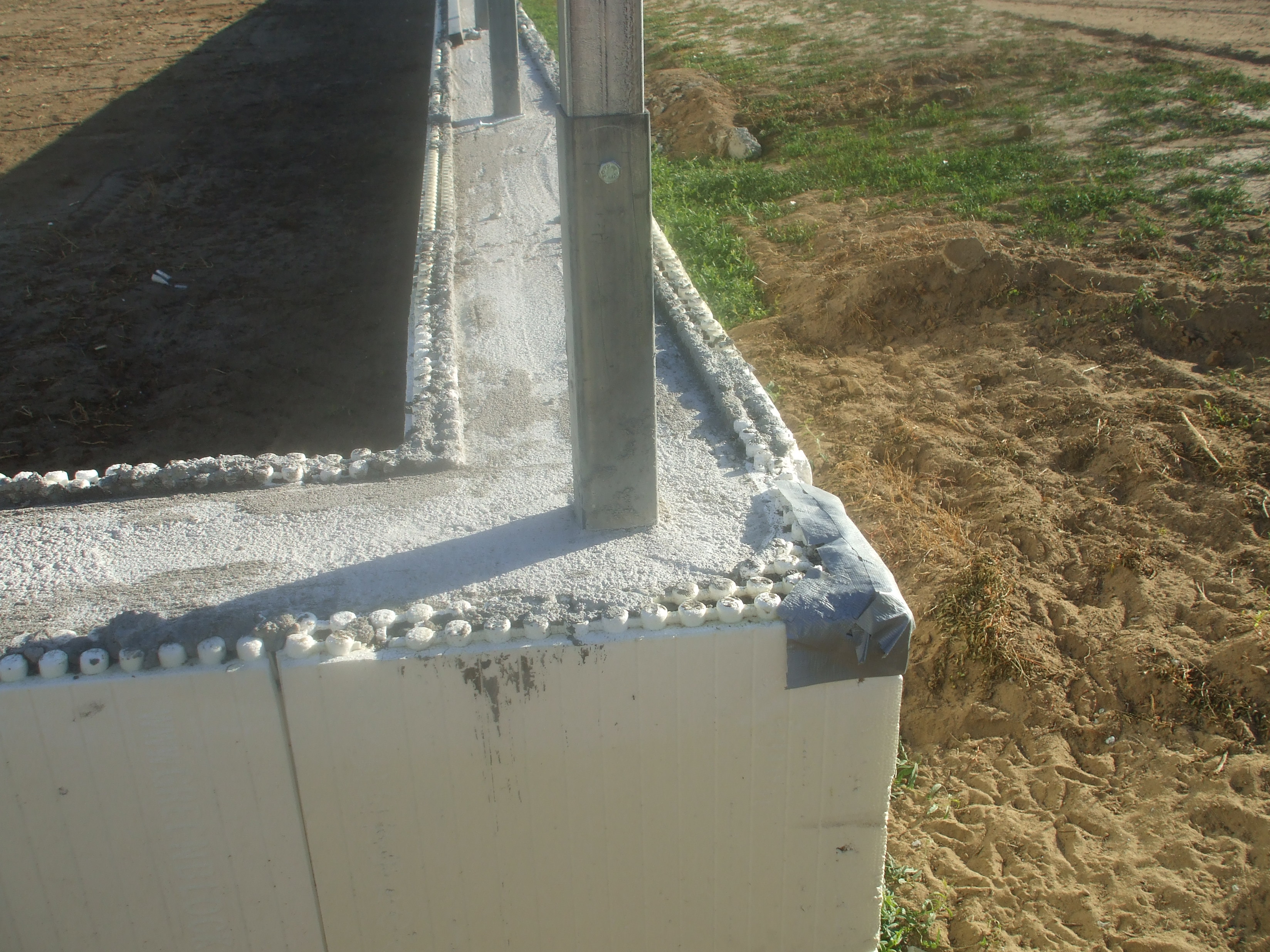
The picture is what the numbs/bumps look like before I removed them.  Notice how little room there is from the top of the cement to the bottom of the numb – it was about 1/2 an inch.

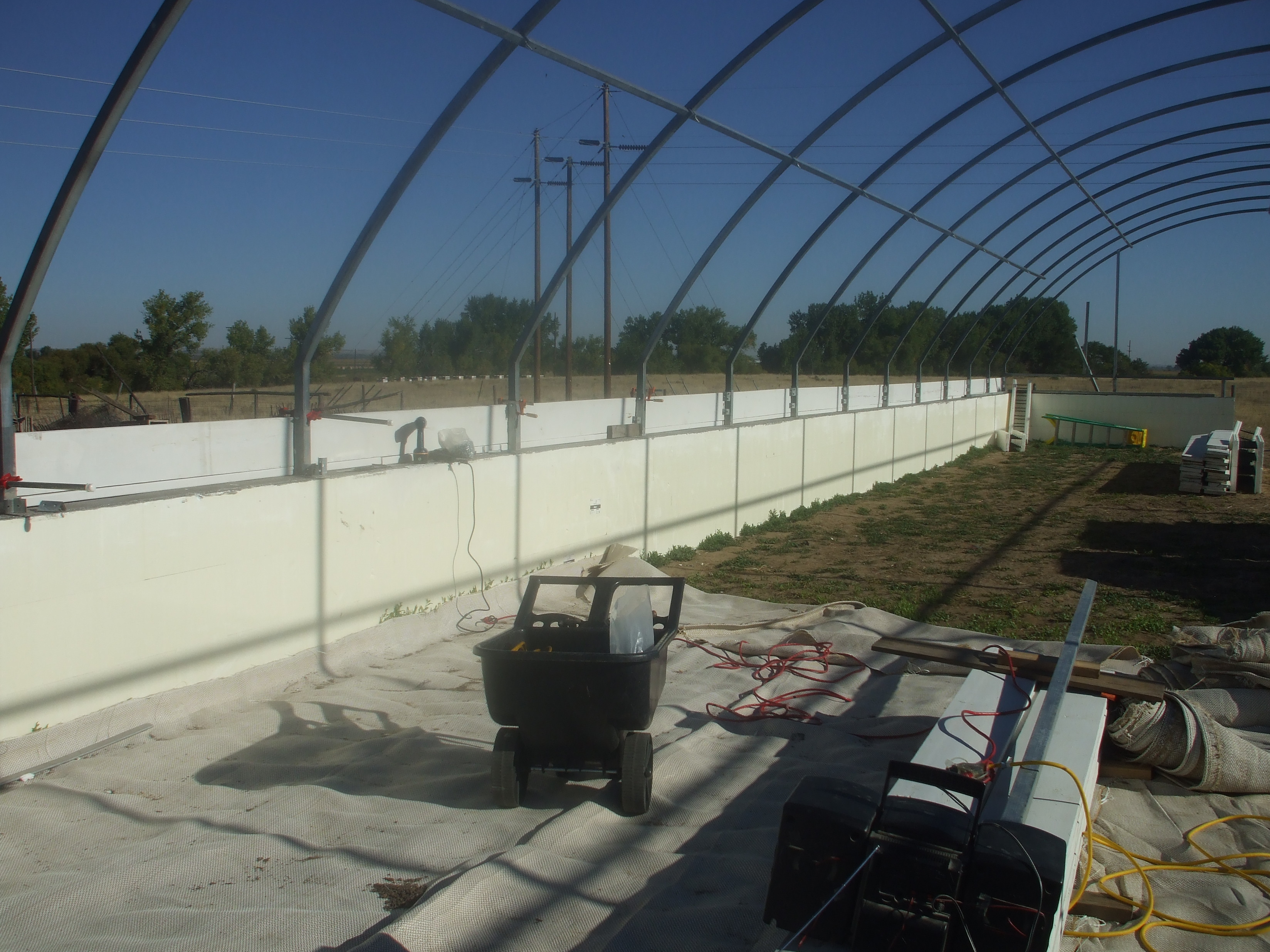
After you can see how smooth and clean I got it.  Notice that the north wall center is still open.  This gave us easy access to put up all the frames, also to carry, by tractor, the heavy ground cloth we obtained into the area.  This is also a good shot of the way the triple insulated wall works.  The cement is in the center holding all the ribs with the extra insulation on the inside and out.  We have already buried the footer in this picture, so you can’t see that there is still another foot below ground supporting all this.


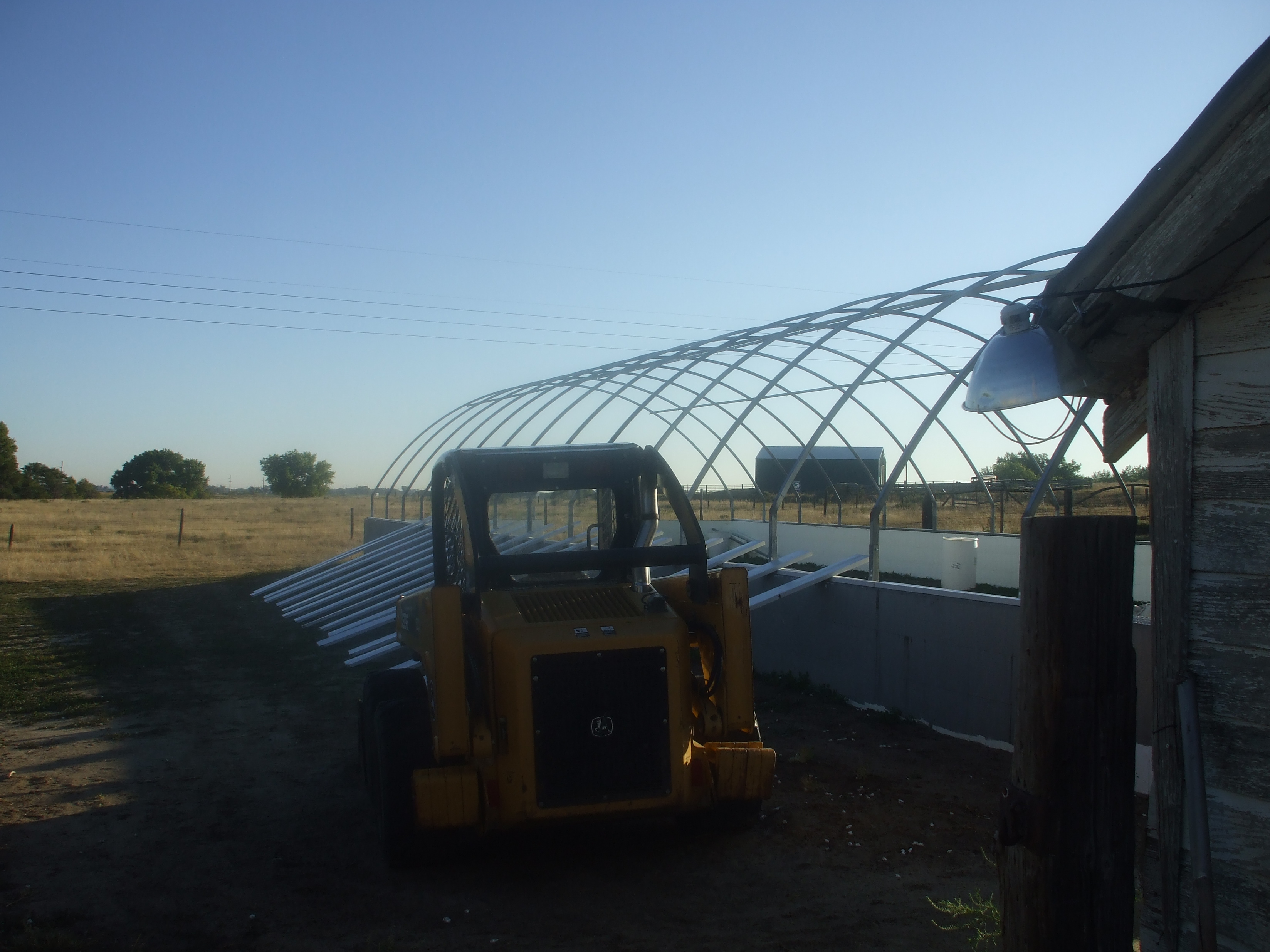
Once the walls were all cleaned and set, 2”x10” boards needed to be installed.  First the boards all had to be painted with the sealant.  I stacked all of the boards along the west wall, leaning on side up on the top of the wall I could work faster.  I would paint the side to the north, then the top then the south side then on to the next.  I worked this way on all the boards, then flipped them over to get the other side and ends.  Seemed to work pretty well except for the extreme heat we were still having.  The whole task of painting/sealing all 30+ boards took a couple of days, but was worth it!  A few bumps and bruises along the way from tripping over the darn things, but I knew they would hold up to the weather now!  (In the picture you can see some of the boards and how they were spread out for me to work on them – in front of the bobcat)

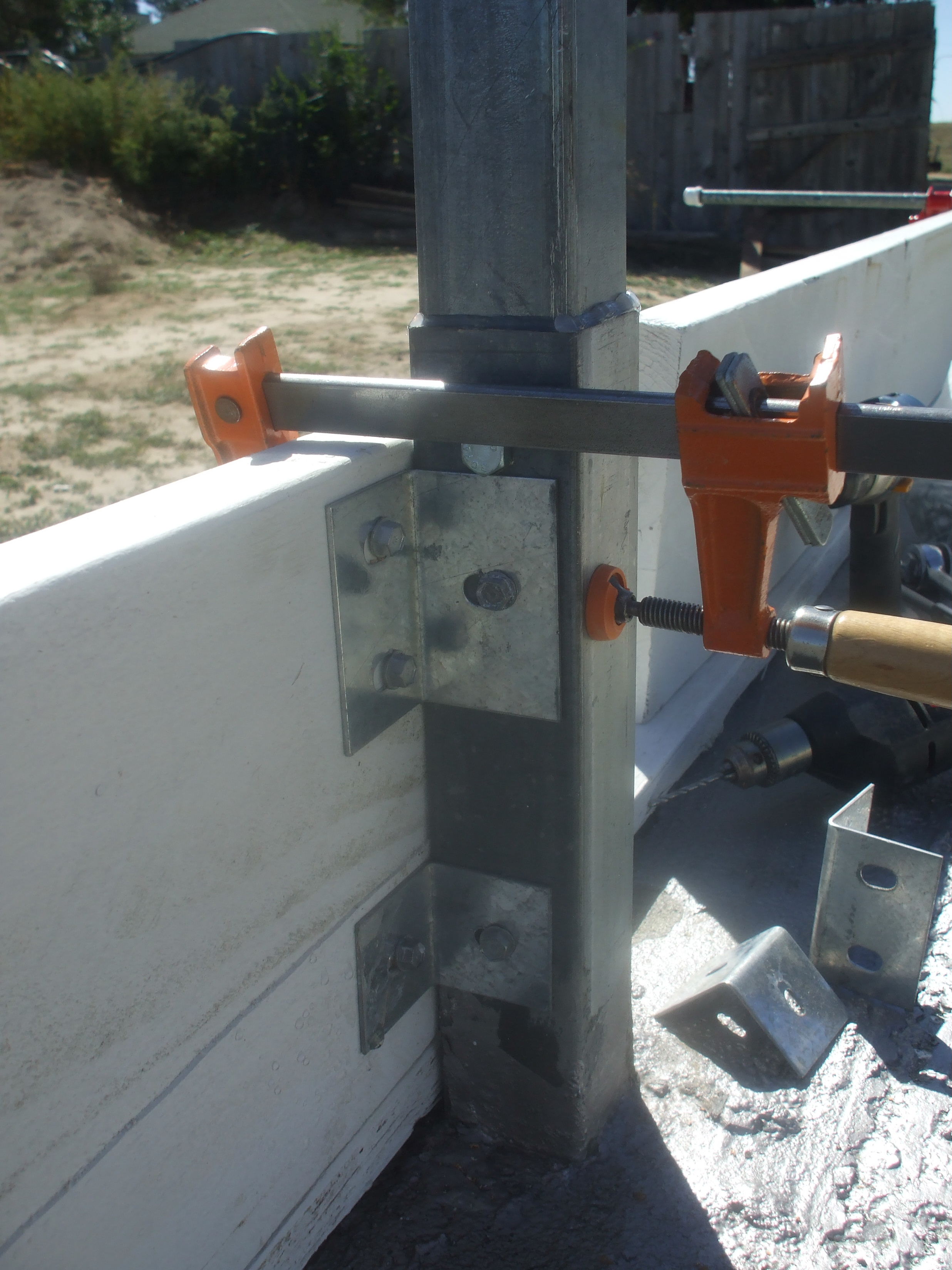
After the boards were all prepped the needed to be mounted.  This was a killer on the shoulders and arms.  I can drill into wood with no problem, but they also needed to be attached to the metal and cement – that was the tricky part.  One 2”x4” board was laid flat, then a 2nd  2”x4” board was placed up right on top of that one pushed up against the ribs.  That was bolted to the ribs and then to screwed to the 2”x4” below it.  Once those were in place, the 2”x10” boards were set on top of that and attached.  Drilling into the wood sections was easy, attaching them to the metal ribs was the shoulder/arm breaking process.  Since there were no pre-drilled holes for any of this process, sheer pressure had to be applied to force the screws into the metal – lots of fun!  It was just me doing all of this.  The boards are 16 feet long and I am only 5 feet 5 inches tall – pretty sure this was a very funny sight to see.  We did find and interesting tid-bit though.  It had rained a bit and at nights moisture would build up on the ribs.  When I was drilling into the metal pieces water started shooting out at me?!  We finally figured out that we needed to seal the tops of the post to stop the water from running down the ribs and accumulating in the posts – that’s where all the water was coming from – inside the footer posts!  Funny how little things like caulking the spots where the metals meet was never mentioned in the blue prints?  Imagine if someone had not done the type of walls we did (which most do not) and they didn’t know this could occur – they could have water damage in the pipes and lose structure integrity ahead of schedule!  That would be sad considering the price you pay for these things.  It’s all in the details!

These wood sides on top of the cement wall needed to be put in so we will have a place to attach the double poly-ply roof too.  There are special clamps that will be attached to the wood to hold the plastic cover in place.  Once I got all of the wood done, I had to go back and attach the guide rails for the clamps to the wood.  All of these had to be in as straight a line as possible and at about 2” from the top of the wood.  I also had to make sure there were no splinters or sharp edges that could possibly rub against the plastic cover.


 In between doing all the boards, we had found some great stuff to use as our weed barrior in the greenhouse.  It was all free for the taking, weighed a ton, had to be cut into sections to move it and then stretched out over the ground.  Cutting alone used up a number of knife blades as the stuff was very thick.  It’s made out of the exact same materials that ordinary weed barrier (like the stuff you use in your own yard) except that it’s made thicker.  It allows water to flow through, but no weeds to pop up – great stuff and it was free for the taking!  Gotta love the price!


WORKING WITH METAL ON 100+DEGREE DAYS-OUCH!

I want to apologize to my readers for not getting a post up sooner – got the spring fever bug from all this perfect planting weather we have right now.  Got my potatoes and onions in and covered (just incase a hard freeze sneaks in before May) so I’m ready to write again! This first picture shows the finished cement walls with the steel footer posts installed.  We had to wire the posts to the rebar to hold them in place.  They were wired at the top and middle areas – gotta tell you, reaching down into the space to wire up the middle caused a bit of blood to flow.  Funny how many things you don’t think of as sharp until they cut you!  Oh well, what’s a good project without a little bloodshed?

building the metal monster

putting parts together

   Check out the far wall-inside…it looks like shadows in the picture but it’s actually a ½ section of the roof framing.  Keith is working out how the 2 pieces are to go together for lifting and placing.  First we tried just laying them out on the ground to match the centerpiece to the 2 sides – didn’t work and too much dirt got into the piping.

 Then we tried setting a barrel in the center of the area with a ½ piece on either side.  The ends were on the ground, which was not a wide enough space for the whole thing put together.  We finally decided that placing the ends on the top of the wall, putting a barrel under the middle of each of the sidepieces, then a barrel at the center where the connector piece was worked.  It took about an hour at first to get everything level enough so the ½ sides would fit into the center connector.  After about the 6th one we got the time down to about 30-40 minutes for connecting – not bad for amateurs!!

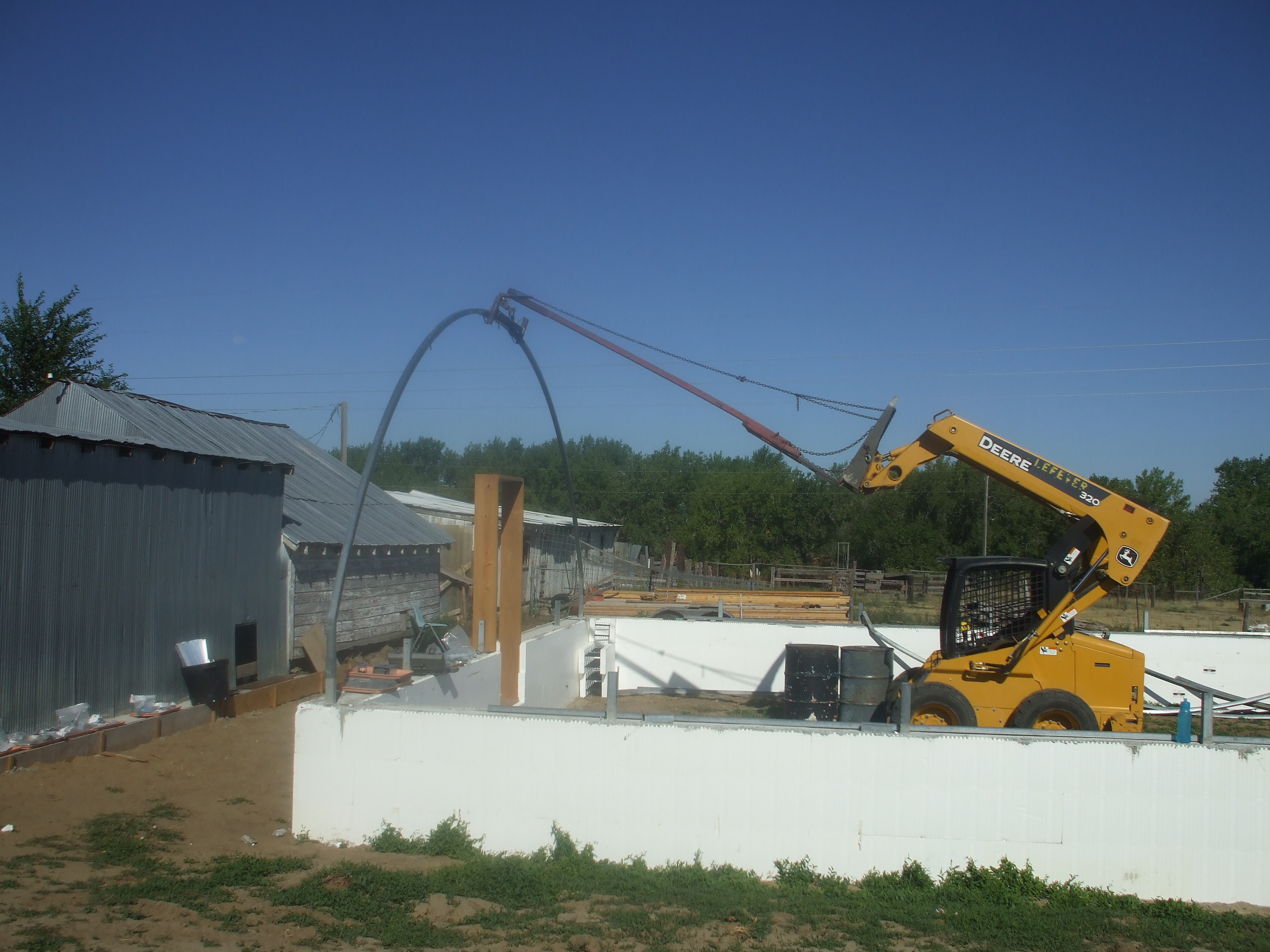
 This next picture with a beautiful shot of me in all my glory (remember – its over 100 degrees out – we found that soaking a white cotton cloth and wrapping it around our heads, like in the picture, actually kept us cooler.  At least until the cloth dried and had to be re-soaked, unfortunately that only took about 2 hours on those really hot days!) show how the skeleton frames went up.  Keith is so smart and talented (couldn’t ask for a better friend!) that he actually constructed a special attachment to his bobcat  (see the long arm extending up from the bobcat to the top of the sections) that we could lower and raise to put each section in place.  I know that big construction companies actually have special equipment to do this sort of thing, but since we are neither big nor a construction company – I thought it was pretty ingenious of him!

proof I work!

Me in my glory-proof I worked on it.

We had to put together the 2 halves with the connector, and then attach the special arm from the bobcat with chains to the full frame.  Once all strapped together (not too tight because we had to be able to get the chain off the frame once it was secured in place – that fun trick was done by Keith shaking the bobcat causing the chains to unhook – freaky huh?!?) he would life the monster up into the air and, with my guidance, we would slowly move forward and backward until I could slip one side into the footer post and secure a bolt through it.  Now this is where the “hot metal” part comes in.

In order for me to get the frame to fit into the post I would have to push and pull the monster around.  At first it was not so bad – it was early morning and not hot yet.  Then, by around 11a.m., things started heating up.  Keep in mind we have all the parts laying out there for us to just grab and set up the next one.   Well, by 11a.m. I was not thinking about that fact, and just grabbed the next piece (that had been sitting in the sun all morning) to work on and proceeded to get 1st degree burns on my hands – IDIOT!  Gloves are a really great thing – when used (stupid is as stupid does)!!!  I tried a long sleeve shirt to protect my arms – but couldn’t stand the extra heat – so my arms got a bit of damage before we were done.

The picture below is a great view of some of the angles we had to go through with the ribs to try to get them into place.  The metal footers we were trying to hook into were only about 2 feet tall and 4”x 4” in diameter.  The ribs stand at least 20 feet from the top of the walls at center.  We are also down in the ground about 2 more feet inside the greenhouse.  So that gave us quite a lot of metal to play with in quite a bit of space.  The ribs alone took 3-4 days to get them all connected, up, placed, and secured.  That included some time with some really nice winds deciding to show up and “help” us!  That kind of help we could have done without.  Breezes were very welcome, but these were sand blasters!

how to handle the monster

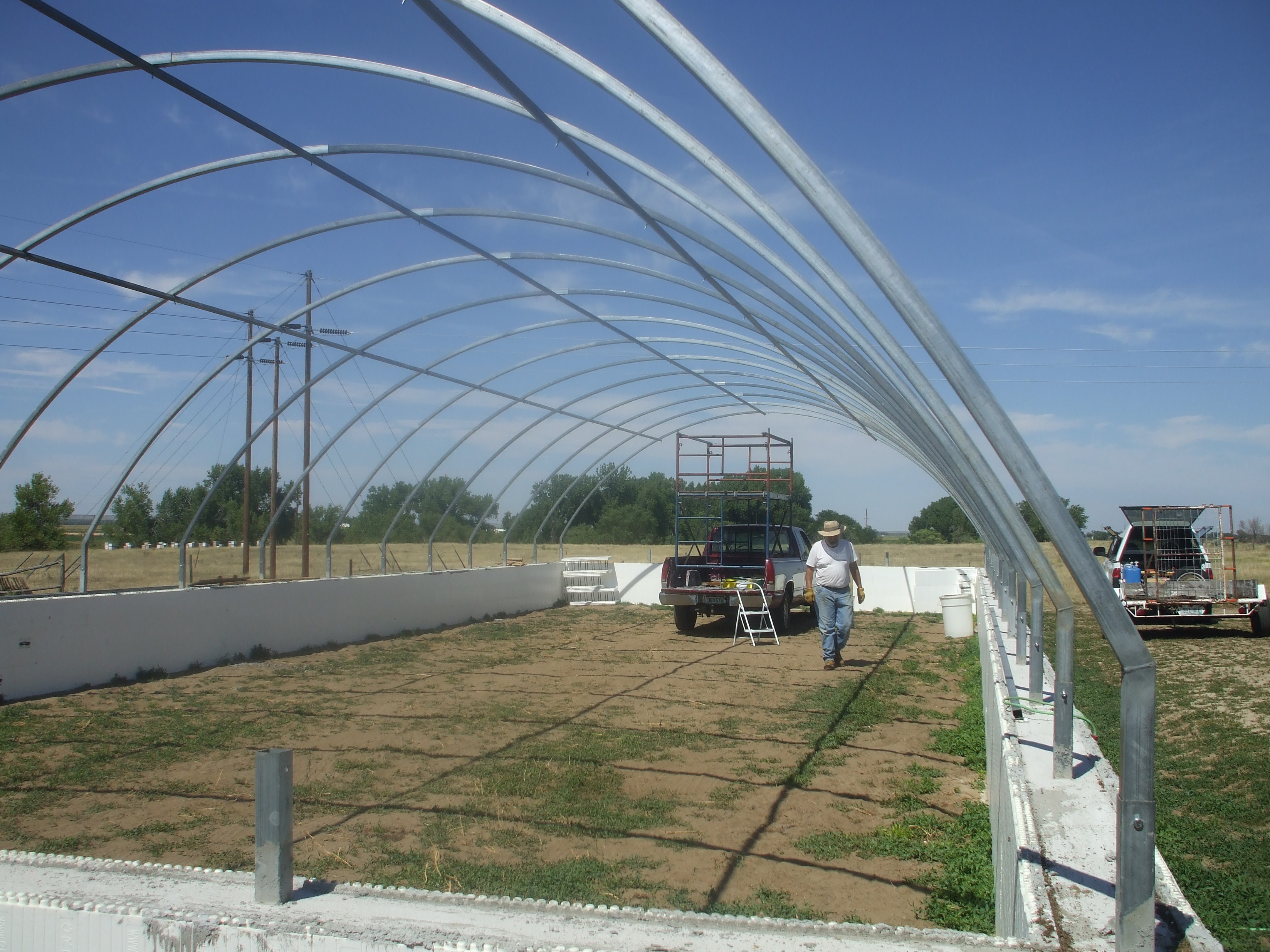
In the end we installed 16 monster ribs on our beast!  Once they were in place the support pieces had to be attached to keep our ribs from separating and snapping off in our winds.  That took additional strength, in more ways than one.  There were no pre-drilled holes for these parts, so a lot of measuring and drilling needed to be done, and drilling up over your head or at a shoulder angle is the worst!  Take some aspirin before bed but expect to still wake up with little to no arm movement the next morning.

 Now I’m great on the ground, ok about 2 or 3 feet up – but scaffolding on the back of a pickup truck, putting me up about 20 feet – EEEKKK!!  Neither Keith or myself are “spring chickens” anymore, but I don’t consider myself (or him) to be at deaths door either.  I found out that I cannot climb the side of scaffolding now like I climbed up into our tree fort as a child, but with the help of a couple of ladders I could get up on top!  It’s a good thing it had side rails or I would have gone right over the edge a couple of times (one child like thing that I still do – not pay attention to where my feet are going!?).  I was too busy trying to get the darn things where they should be that I was not paying attention to where my brain was directing my feet to go – dumb think to do when you are 20’ off the ground!  Most of the time Keith did the installation (yea!!) since he is stronger – however his bodily functions are not much better than mine, so by the end of the day we were both beat.  I have to admit that a few times during our construction process, we did have to take a day off to recoup.

When all was said and done – it looked pretty awesome!!  We were very proud of ourselves and the fact that just the 2 of us put all these up – no major professional equipment – no professional contractors.  In retrospect, it was a pretty outstanding thing that we did, and I’m very glad we did it!  I’m a thinker by nature; I need to know how things work and why to understand them clearly.  By building this thing from scratch ourselves, I feel more connected to it.  One of my main goals is to know every inch of it, how it works and why it works incase something, in the future, needs to be fixed or replaced – I can say “I know how to do that!”

great supports

excellent support system in place.

The next phase is to clean up, seal and install end walls (God save my poor tiny knuckles!).

The Greenhouse Project – Interesting Guest.

snake n the toad


July 5th, the footer is hardening and a fun, but scary, thing happened that morning. 

The sun was just coming up and I went out to open the gates to the south for my sister to head off to work.  Stepping out the door I spotted a snake.  I assumed it was dead since the darn thing was only the width of my thumb (about a foot-and-a-half long) but it was trying to eat a toad that was about the size of my fist. 

Curiosity made me examine it closer.  Its eyes were actually bulging from trying to stuff that whole toad into its tiny mouth.  I know they can extend their jaw to take in larger objects, but really – what was it thinking? (Apparently,  I’m not the only thing on our farm that tries to bite off more than it can chew!)

I went in and grabbed Darcy telling her she just had to come see this snake.  I told her that I had never seen one like this with a bright red stripe down its back before.  We have the normal garden snakes, bullheads, and rattlers – but this one was different. 

She came out to look and saw that  the stupid thing decided to dine right in front of her truck and she didn’t want to run it over (WHY NOT?  Its already obviously dead from gluttony!), so she picked up a stick to scoop up the snake to throw it into the front yard garden (feed the worms)…. AND THE DARN THING DROPPED THE TOAD AND BEGAN MOVING!  It wasn’t dead after all! 

That move totally freaked us both out, but then it decided to run off – not like a normal garden snake going straight, sort of wiggly, ahead – noooo, it pulls this sidewinder trick like the rattlers do – FREAKED OUT AGAIN! 

Now we had no clue what type of snake this was, if it was dangerous or not.  We just looked at each other and started laughing!  It it’s something bizarre, it’s gonna end up at our farm!  She then jumped in her truck and left for work.

I  got on the internet and started searching for the freaky thing.  Turns out it was just another type of grass snake, but not usually found around here!  I blame it on Excel Energy.  They spent over half of the year  digging down in our swamp area.  They were removing old poles and putting in new ones.

Just below our farm and before the railroad tracks is a nice little woodsie/swamp area.  We have heard the coyote’s down there, foxes and seen the occasional deer in the neighbors hay field, but this summer brought up all kinds of stranger critters.  Red-headed woodpeckers (I really though they were extinct!) appeared in numbers one morning.  Hung around for a few days but after the big trucks left the swamp/woods, they were gone.  I had words a couple of mornings with a small vulture.  It got about 10 feet up over my chickens as I let them out of the barn.  We have condors that pass over twice a year during migration, but this guy was cool.  All black with a brilliant white head circling around the flock.  (I told him to go eat the rats in the field and leave my chickens alone – guess he agreed cuz he never took off with one.)  He hung around most of the summer.

We even had a muskrat driving our dog nuts in the front yard for a day.  Ugly looking thing with huge scary teeth and claws.  Had to call the County Exchange office on that one since it got ahold of our dogs nose and wouldn’t let go.  We found out they are one of the few things out here that does not carry rabies – yea!  But, of course, our dog did not learn to leave strange critters alone.  She still chases anything with 4 legs – idiot!

We get eagles and hawks   out here at any given moment, but the birds, snakes and 4-legged crawlers this summer were very interesting!  Can’t wait to see what ends up getting stuck in the greenhouse once we have the roof on! Eeek!!!

The Greehouse Project-Construction Starts.

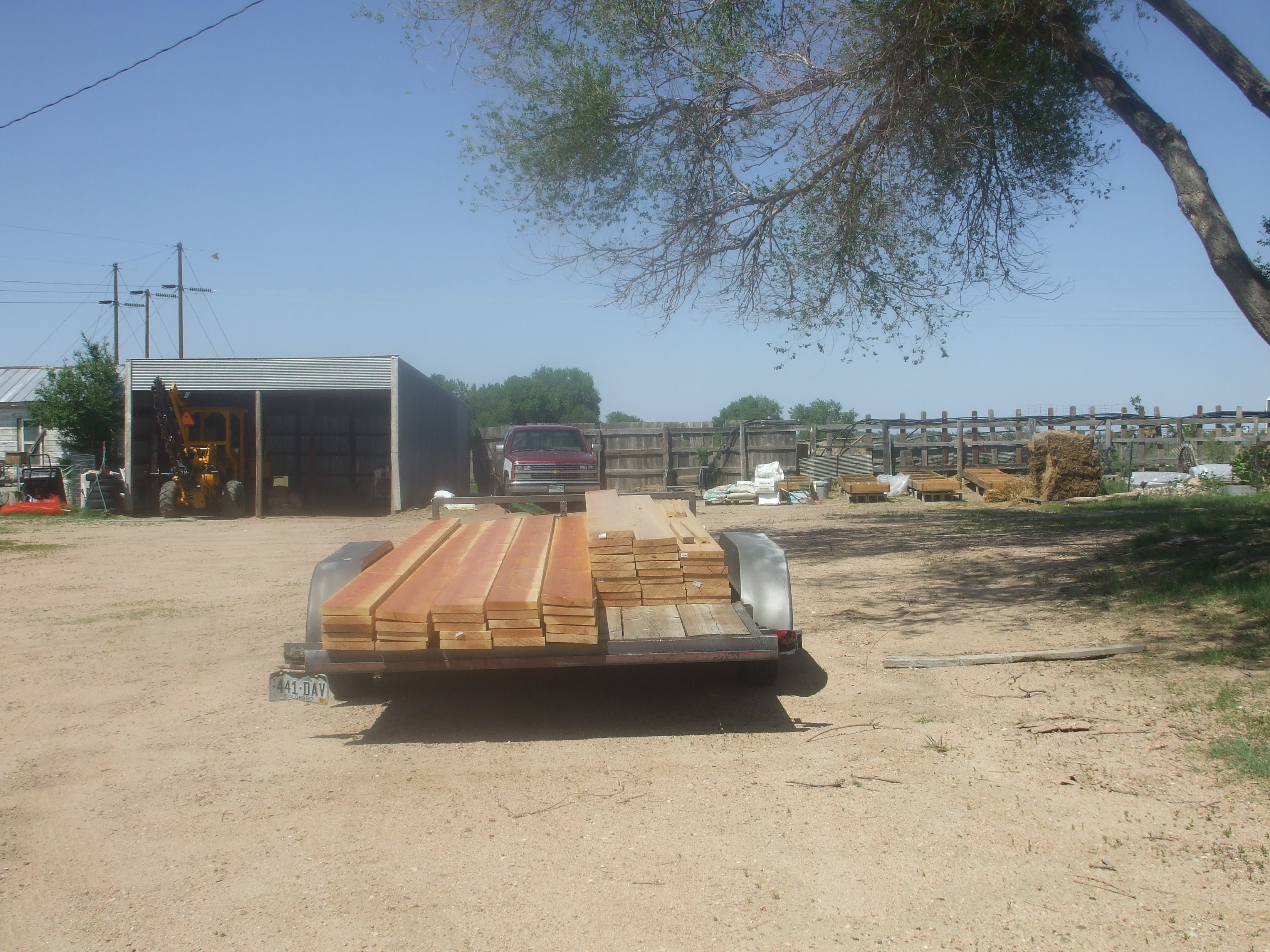
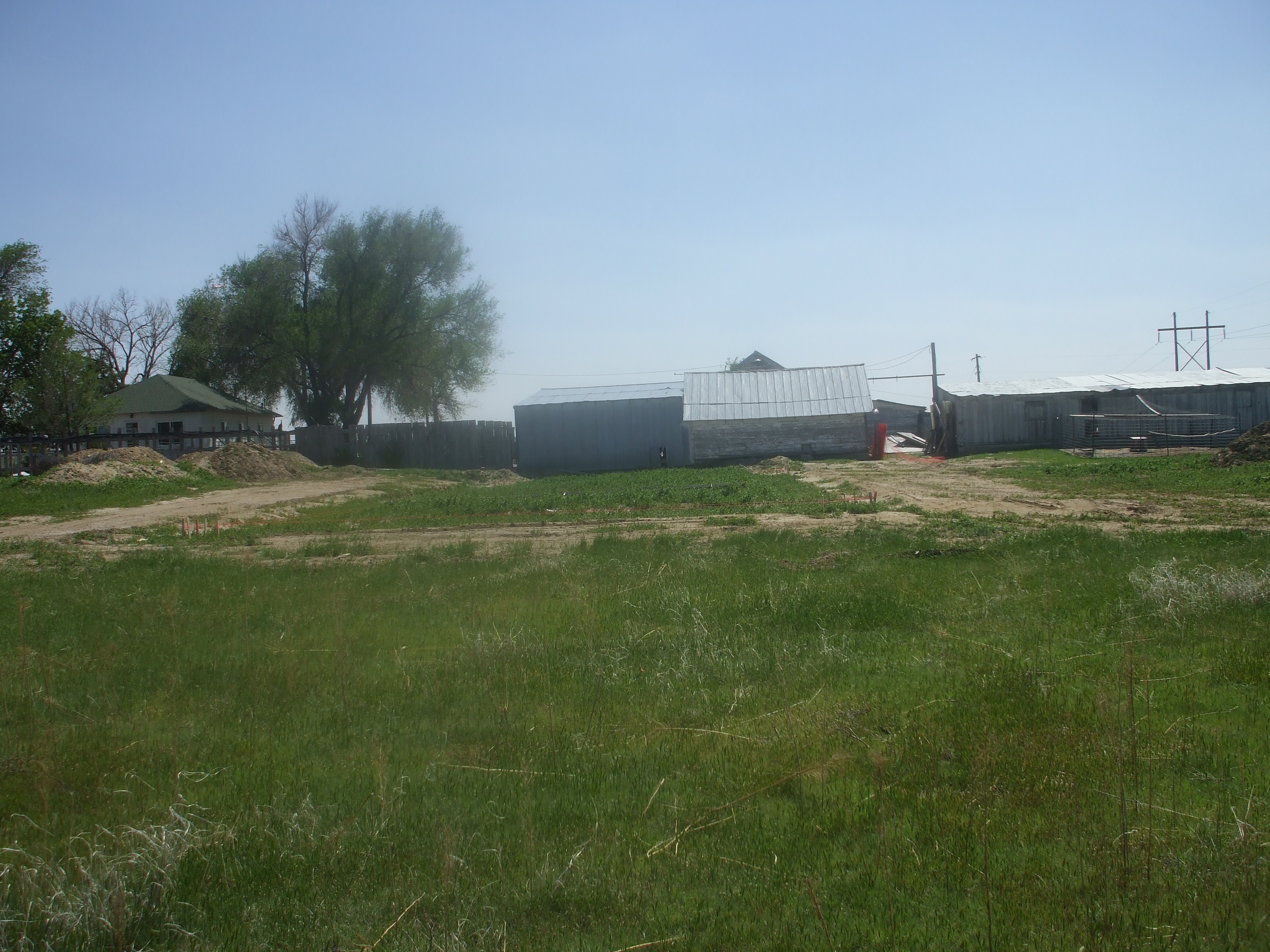
June 3, 2011: We leveled the ground over the last 2 months. It took 2 months due to a large variety of personal intrusions. I call them intrusions because they were nothing that was planned but things that needed to be attended to. If we were allowed to just do what we had planned when we had it planned, then everything would have gone according to plan and we would have had sales by September 1, 2011. Unfortunately nothing in this whole project went according to plan.

The original greenhouse structure called for it to be on the ground. If you ever look at a city garden greenhouse, they usually have metal posts stuck into holes in the ground with cement poured into the holes to hold the post in place. Now some places will just clamp the cover down on this, others may have a 2”x10” board running along the ground then clamp the cover onto that. After several lengthy discussions amongst our team, we decided that we wanted to be able to use as much space in the structure as possible. In order to do that, we needed at least a 3’ high wall. In order to create a wall, we needed a footer.

I have built a number of things in my past, chicken coop, fences, cages, garden stuff etc., but nothing that required a “footer”. I had no clue what a footer was until this project. Turns out that all it is, is a 1-foot block of cement running around the base of a project – wow – footer – who’d a thought it was that simple-a foot equals footer-wow! Construction for creating that thing was not so simple.

We purchased our first major set of materials – 2 different size boards, wooden stakes, rebar (Which is just a piece of wire multiplied by the size of the Incredible Hulk! They can run even bigger, but we just used the half-inch size. It does bend, but you need a machine to do it – ours was just a manual one so all my muscles – or lack of – got tested…I failed!), water/weather proof paint/stain for the boards and special wire that is shaped to hold rebar in its place while you pour the cement, a whole wagon full of stuff!  This was shaping up to be an enormous learning experience for me, and silly me and I was all excited about it!

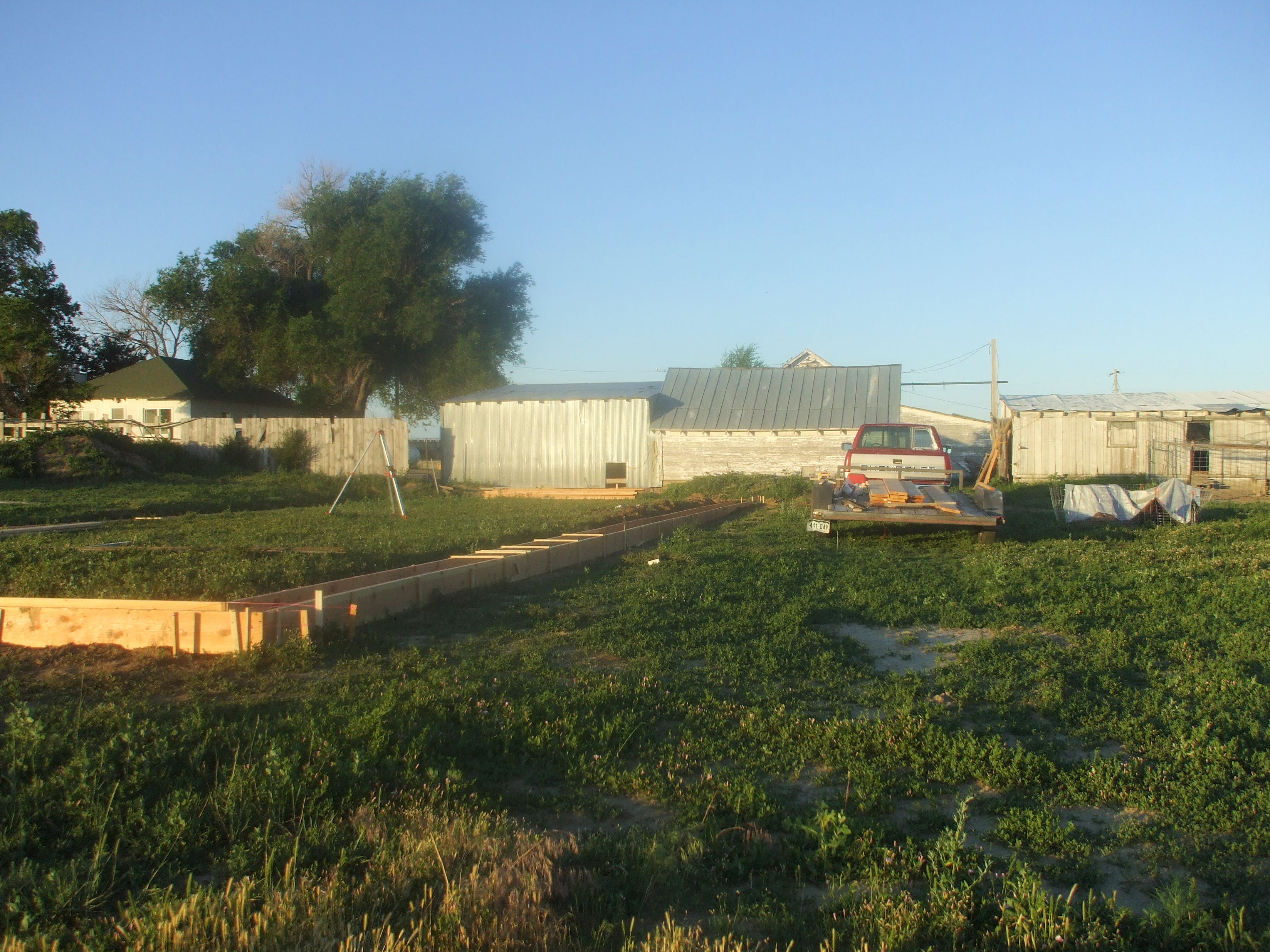
Once you have gotten the ground as level as you can (Keep in mind you will always have some curves and divots and the wind will sneak in when you are not paying it enough attention and really screw up your work!), the next phase is to set up your forms for the cement to get poured into thereby creating a footer. Sounded easy enough so I spent several very hot days painting all the wood pieces with the sealant first.  Since we were going to be pouring wet cement on/into them, and since we hoped to use them again later for other parts of the project, this step was critical.

The combination of 90+ degree heat, sticky waterproof stuff and biting black flies are a real fun mixture! The only relief I got was in the form of a brief afternoon storm almost every day. Once the clouds started to build the wind would kick up (ahhh, my friend the wind – jerk!) and that was my signal to get the wet boards covered so the sealant would have enough time to dry – before they get wet. How moronic does that sound? It took 3 tarps to cover the wagon I was using to paint all the wood on, and I swear the wind knew exactly which corner to blow into while I was trying to tie it all down. Tie the northwest corner down then run over to the northeast –oh – wait – the wind decided to blow in from the southeast and throw my tarp up over the whole mess. This usually went on until just before the rains started. The real fun part was within about an hour, the rains would stop, sun would pop back out and then I could go out, uncover it all and continue till nightfall.  Nightfall meant wrapping it all back up again (Our peacocks liked to perch on it at night – not fun trying to paint and running into wet peacock poo!).

After about 7 days I had it all done, time to move on to setting it up. Just for grins and giggles, take a trip to your nearest lumber supplier this weekend. Request to see a 2inch by 10 inch by 16-foot long board of pine. I dare you to try to lift it yourself. I had been in a “desk jockey” job for the last 20+ years – what was I thinking? Yes we had a farm again, yes I could still throw around a 50lb bag of feed or a 70lb bale of hay pretty good, but this was a totally new animal.

 The weight didn’t throw me off as much as the length. I was also stupid thinking it would help speed along our project by unloading each one of them and setting them out, on the ground all the way around the inside and outside of the area so we just had to put them upright and slap them in – IDIOT! When you set them on the ground, even with the weather treating, they will warp – and these did! When Keith saw what I did he was so nice about it (he laughed!), politely stated that they can’t be on the ground and should all go back on the wagon. He didn’t even offer to help me put them back, just kept giggling!

So, after several hours I got them all back on the wagon except the one he was working on. This was used to start in a corner. Holding the board upright on a 2” side (so its standing up 10”) you have to level it in ALL directions. A little more dirt under here, a little less dirt under there and after about an hour, you have 1-board leveled. When you are absolutely sure it’s as level as it’s going to get, you pound I the wooden stakes – outside only- then use screws to attach the stake to the board to hold it in place. All the while making sure you did not cause it to become unleveled.

With nice straight boards would have been a great time/body saver, but no…I had to bring a challenge into the equation with my warped boards. It was loads of fun trying to push-me-pull-you on the massive boards to try to get them all in line.

Once all the boards were set with the stakes screwed in to hold them, rebar was then run 2 sets parallel to the boards about half way down. This is where the funny special bent wire came in.  We screwed 1″ boards across the top about every 2 feet.  The wire was then strung from the boards to hold the long  rebar pieces suspended as to allow the cement to flow all around it. (The rebar is supposed to add the strength and flexibility to hold the structure as the weather moves the ground.)

Once the cement is poured I had to run along behind the cement truck shoving 4-foot high rebar rods straight up and down into the cement. I had to make sure it was in a specific spot and the cement was slightly set so the rod would not fall over or slip out of place. (Learned a lot about cement that day – like it can burn your skin if it sets and dries on it – OUCH!)

After all is said and done and the cement is totally cured – all the wood gets removed!  Nice huh?  Spend days putting it all up, just to tear it all down.  So, June 3rd we started the footer project, on July 9th it was done – cement and all! Next phase is the special 3-foot, triple insulated (ya, we had a meeting and decided that just cement insulation was not good enough), sidewalls.

THE GREENHOUSE PROJECT The Plan Gets Twisted.

leveling the ground 

We bought the farm in August of 2000. Within a few months after that we put down the funds to purchase the greenhouse kit and parts started coming in – not all at once but in multitudes of truckloads.

Over the course of about 5 months we received truckload, after truckload, after truckload of materials. Boxes, pipes, and crates, all sizes and shapes. We would have to take off work to check the shipments because, without fail, there would be damages. I don’t remember a single load that didn’t have something bent, twisted or broken and had to be returned. We knew that we had no clue how to put this thing together, so the last thing we wanted to have to fight with was damaged goods.

We were also very aware of what we spent for all this – so it better be brand new, undamaged stuff. The quote we were given for our kit stated that it “included shipping costs”, so a bit of a war started. Since we refused to accept the damaged goods and sent them back, new materials would have to be shipped. This incurred additional shipping costs. The company then wanted us to cough up about an extra three grand in shipping, to which we refused! We were guaranteed a quote, we paid in full up front, and we did not damage the materials! The battle was on.

The new materials were always sent, but now they were also sending us billing statements spouting “amount due”, which we promptly returned with “paid in full” written on it. The next year was 2001. Our battle still went on with the company over the shipping charges, but in the fall of that year a major US battle was fought – 9/11. During the course of that year we also had major setbacks.

My daughter learned to drive, was turning into our driveway and a man (with out a drivers license-too many DUI’s, and no insurance) crossed over a double yellow line and barreled into the driver’s side of the car. His van was hardly hurt, my daughter was shook up but ok since she was not moving very fast but the van was moving fast enough to total the car. The age of the car meant total loss as far as the insurance was concerned, but no funds for a new one.

Then we got a call from our father’s brother in Nevada, he was dying. He had no wife or kids, but we loved him and agreed to be his executors. He needed us to be in Reno as soon as possible. This was a Wednesday in early August 2001. We packed up the SUV, took emergency medical leave from our jobs and drove to Reno Nevada. A little over half way there, the SUV started breaking down. It was not that old, had been taken very good care of, but just couldn’t stand the strain of a long distance trip anymore. We managed to barely get into Reno and it died. We got to the hospital late on Thursday and he died Friday morning. We spent almost a month there handling his affairs. It’s funny how much you DON’T know about a person until they die. This was just one of a number of bad unexpected things that happened that year. So between the problems with normal life, and problems with the greenhouse company – our greenhouse stayed packed away (I told Darcy not to unpack anything incase we get mad enough at the company over the extra charges to tell them to just take it all back! Yes, we have very Irish/German tempers and were all set to do just that if they didn’t knock it off!).

Within that year we finally got it through to the company that we were not going to pay for any extra shipping charges – per our contract agreement, and they stopped sending them. The unfortunate circumstances though, now left us with all the greenhouse parts and materials but no time or funds to put it up. So it all stayed in boxes, crates and the large metal frame sat on pallets our in our fields. It was to remain this way for the next 10 years. 2011, as fate would have it, turned out to be our year to finally get working on construction of the greenhouse. Our timing, once again, was impeccable!

Pick the worst economy in over 50 years, oh, and make sure you are also in the highest unemployment rate period in the same time span. Then make sure that the job prospects are few and far between. Once you have all that in place – start a new chapter in your life – BRILLLIANT STRATEGY! Really?

framing materials center left

The original thought was to not leave my job until June – that became March. Then get a small loan to help with construction costs – that became my life savings. Have the whole thing up, running and producing sales by September – that is still in process.

My job had been slowly killing me for the last few years. What started out, as something to be proud of –helping people find safe, decent housing at a reasonable price – became a mental and emotional nightmare! I was not sleeping, hadn’t for over 24 months now. I was not eating right, blood pressure was elevated, weight was going up then down, and it was pure torture to get out of bed to go to work. I just didn’t want to deal with the lies and lines anymore. Sympathy only goes so far once you see the ugly side of people, and I saw way too much of it.

The amount of energy a person will put into creating a lie just to get free government assistance astounds me! If they would put just half of that energy into something constructive, imagine what a great place the U.S. could be again! I just couldn’t live with it all anymore and my health was proof of that. So instead of leaving in June, I moved it up to March – no job should be worth your life! (Unless you unfortunately are in the military – and that is a sad truth! I have lost a number of loved ones that way – would love to see a day when all that ends!).

So I quit under hazardous conditions – scared to death to do it, but it was either the job or my life – kinda wanted to see my grandsons grow up a bit!

Then the bank wanted us to split our already small property to allow the greenhouse its own space – just incase we fail – nice huh!?! They were already looking at this project as a failure! (And the world wonders why people don’t trust banks anymore?) We have less than 20 acres as is, and this was to be our retirement – not some strangers if it fell through! The one thing we knew from the beginning was that even if this idea didn’t work, we would have a great winter hot tub house, or winter chicken run. Whichever direction it took wouldn’t matter – it would still be ours!

So we turned down the bank and decided to pull out my life savings retirement fund. Another unexpected twist. The process to pull out “my” funds was agonizing! It took over 2 months to complete the request and the penalties were ugly – but in late May we finally got it! Well, it soon became June 1, 2011 – I had no job, no job prospects, barely enough funds to start construction, and we agreed to have one of our best friends (he has a great background in electronics, construction, farming, and thinking outside the box) partner with us on the project so we could build it ourselves instead of hiring a construction company – look out September, here we come! What were we thinking – really?

THE GREENHOUSE PROJECT-The Original Plan

When we bought the farm in 2000, we knew a couple of things to be true…1) We wanted to become self-sufficient, 2) We knew that social security would not be there for us by the time we retire (which is a very sad thing-but that is for another “soapbox” story about how screwed up our government has become) even though we have paid into it for over 30+ years, 3) If we were going to survive after retirement, we were going to have to create our own business – something that everyone would need.

Then it came to us – a greenhouse!  Not some dinky backyard, just for yourself size, but a big one!  But we still wanted something different, something that was unique and would feed us, our family and friends, and still provide enough to sell and earn and income for our retirement.  We also wanted something to pass on to my daughter – a farm life better than what we had as kids (and that was going to be pretty hard to beat).

I used to get the Mother Earth News magazine back in the 70’s and 80’s.  It started out as a great magazine, but in the 80’s something happened, it went too commercial.  Then I found out about Countryside magazine and that was where our greenhouse ideas came from.  We were going to grow in the ground in the greenhouse.  We didn’t want above ground on tables like the big commercial growers do, and we didn’t want to just sell plants.  We wanted to sell food – good food – healthy food.

So, the original idea was to have a large place where we could grow enough food for our family and still have lots to sell and produce an income – great idea right!  We had enough escrow from the sale of our homes in Denver to buy an 84’x30’ greenhouse kit.  Kit is the operative word here and we were in for a shocker!  The whole thing took months to deliver and was in boxes, crates and metal pipes that all came in separate shipments from several different places.  We thought we were purchasing from a company right here in Colorado – surprise, not!  The “hub” is here in Colorado, but they actually purchase parts from all over the country (ahhh the things you learn when you’re not paying close attention).

We paid roughly $17,000 for the thing, which was supposed to include shipping.  Then, in the course of things, they wanted more money for more shipping?  Well it wasn’t our fault so many parts came to us damaged (P.S. people – make sure you check every shipment!) and was returned for replacements.  This was our future so we wanted to get it right the first time. 

Well, happen as things will, by the time we finally got all of our parts and pieces life kicked in again.  We had no time or money left to actually build the darn thing – so it sat.  And it sat.  And it sat!  For 10+ years it all sat and/or was shuffled around the farm.  We even thought about taking it to the auction to try to sell at one point, but dreaded the thought of trying to load all the separate crates, pieces and pipes.  So it did nothing for over 10 years.

Penny The Pig

There was one other thing that we knew when we bought the farm. Eventually, we wanted to grow our own food. We’re talking ALL of it, not just the garden stuff. So, we closed on the farm in August of 2000.

In September of 2000 we purchased the goats, ordered our first batch of baby chicks, and went to the local auction (its only about ¼ mile from our house so that was easy to find) and bought our first pig. The little female pig came through on its’ own. It looked small and scared and we got her for fifteen dollars – what a bargain (we thought)!

Well she turned out to be the runt of a litter that was why she so cheap, no one wants the runts. We tried to feed her any/everything that we could, but she did not want to eat.

We finally shared our dilemma with a local farmer, and he stated that pigs need others to eat with. They are a very social and emotional critter, prone to bouts of depression just like humans. When they are alone, they can get very scared, depressed and can die of it! So back to the auction we went.

We managed to purchase 2 more pigs, this time fixed males (side note – almost all baby male pigs that go through an auction are fixed, better for putting the weight on). They were a bit bigger than our little girl so we were worried about putting them all together.

The very first feeding of our little group was amazing. The little gal pushed and shoved her way past the boys to get her fair share without any trouble at all. We were so proud of her! Our local farmer also shared an insider secret, feed pigs (especially babies since their immune systems are weak at this age) something wet and warm with a bit of peroxide in it. Peroxide? We were confused. He went on to tell us that the use of peroxide helps to keep their lungs clear, which is a common problem in little pigs. One that can kill them!

So, following his advice, we purchased a 50-pound bag of whole oats (yes – oatmeal in bulk) and began our daily routine of warm oatmeal (with a touch of peroxide) for the pigs. The funny thing about “warm feed” for a critter is that most every other critter will also want some. It was probably a good thing that it went to the pigs because they don’t share! This is, unfortunately, also how we found out that they are omnivores – they will (and did) eat just about anything. We lost some other animals due to their “hunger pains”, something we were not please about or prepared for. Now we know better – keep pigs of any size away from other animals, especially during births.

We continued to give them a warm breakfast every morning even as they grew to full size.  A funny thing happened along the way to maturity, my sister decided to name them.  Now every farmer knows that you don’t name anything that you intend to eat. We even knew that from childhood – but that didn’t stop her. All three pigs were red in color, and so came the names of Penny and Copper, the only other logical choice to her was from the story of the 3 little pigs – she came up with Styx (like the house of sticks, just a fun way of spelling it). 

As the pigs grew, breakfast anticipation became a fun game. My sister would go out and call just one – Penny. “Here Penny, Penny, Penny!” she would yell. That little pig would come running, full throttle, to her voice. Yes, it helped that she knew she would be fed, but more important was the amazing thing that Darcy noticed one morning. Penny was talking back to her! First it just seemed like normal pigs grunting during the feeding. But as the days passed, she/we noticed that Penny grunted back to her even when there was no food. Over time she would yell for Penny and call her “my racin hog” and that chubby little monster would come-a-runnin! Darcy also had started scratching the pig, which made her even happier (since pigs can’t reach ¾ of their own body).

Now we had a bigger problem. She gave them all names, started talking to them, and one was talking back – these were supposed to be freezer meat! When they grew to about 250 pounds, it was time to make a decision. We both agreed that Copper and Styx would become freezer meat, but what about Penny? I came home from work one afternoon about a week before they were supposed to go to the butcher and discovered the answer to my question.

Going through my normal routine – change clothes and do chores, I found the pig’s gate open. I went into a panic! We are right on a highway and next to a major interstate. We are also trotting (pig term for fast movement) distance to the auction. I found Copper and Styx. They were finishing up the grain in the barn – but still no Penny. I scoured all of the barns and sheds, checked the chicken coup because eggs were her 2nd favorite breakfast food, still no Penny.

I headed back toward the house to call the locals – police, auction and any neighbors that lived close enough that they may have seen her, when I notice the dog food that we keep on the porch turned over and emptied (I had just filled it with 50 pounds of food a few days earlier). What was into that? Then I realized, Penny must love dog food (not surprising really, since they do eat meat and veggies)! I decided to check the front of the house to see if she decided to go there under the trees.

I found her up there all right. We were in the first of our drought years and what little water did fall created a natural stream path through our front yard. Penny, being as smart as she was, discovered that one area between several trees was damp, cool, shaded and best of all, perfect for her nose to dig into. She dug up a hole big enough to fit her whole body, and then some, into it. A full belly of dog food, cool mud to lie in, and trees to shade her – what more could a pig ask for. I began to laugh quietly as I didn’t want to wake her.

Darcy came home about one hour after I discovered her Penny. She came into the house and I told her to follow me. After putting her purse and things down, we went out the door to the east of the house in the front yard. I asked her to tell me “what’s wrong with this picture?” It took her a bit since 1) this was not a normal thing – pigs escaping 2) Penny was so covered in mud that when she was lying down, she blending right in with her surroundings. She finally spotted Penny and burst into laughter! I joined her and said; “Ya know we can’t get rid of her now, she can be used as our organic garden tiller!”

That was the moment Penny the pig went from being freezer meat, to being Darcy’s favorite pet! She loved her dog Bubba, but Penny had her heart!